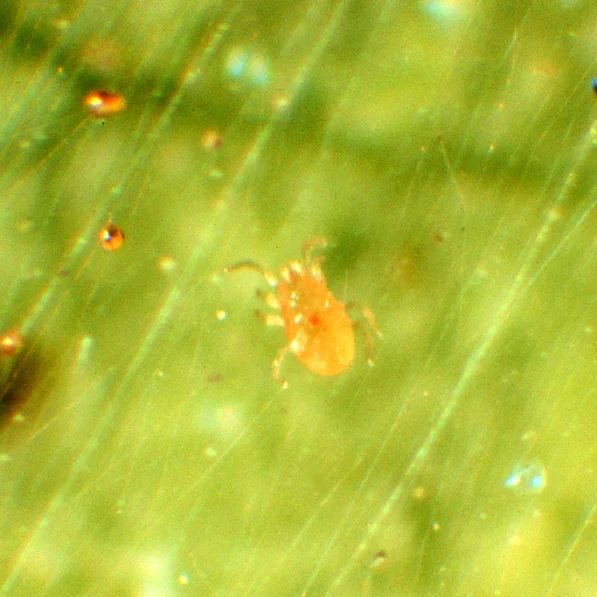
About Predatory Mites
Predatory Mites (Phytoseiidae and related families)
Beneficial Mites
Found wherever spider mite populations occur, on the undersides of ornamental foliage, in turf canopies, and on vegetable and small-fruit crops; active during warm, dry weather when pest mite populations spike.
Predatory mites in family Phytoseiidae are tiny (0.02-0.04 inches), pear-shaped, and translucent to pale orange, significantly larger and faster-moving than the two-spotted spider mite (Tetranychus urticae) they commonly hunt. Each adult can consume 5-20 spider mites per day. Several genera are present in Tennessee landscapes, including Neoseiulus, Amblyseius, and Galendromus.
Native region: Multiple Phytoseiidae species occur naturally throughout Tennessee; additional species are commercially produced for augmentative biological control.
In Middle Tennessee's humid summers, spider mite outbreaks on ornamentals such as hollies, junipers, and roses are frequently self-limiting when predatory mite populations are intact. The key driver of predatory mite collapse is broad-spectrum miticide use, carbaryl, bifenthrin, and many pyrethroids are highly toxic to Phytoseiidae while providing only short-term suppression of pest mites, which rebound faster than predators do. If a miticide application is necessary, selective options such as abamectin or spiromesifen have lower impact on predatory mite populations. Avoiding dusty conditions on plant surfaces (which impede predatory mite movement) also improves natural control outcomes.
Quick Facts
- Common Name
- Predatory Mites
- Scientific Name
- N/A
- Category
- Beneficial Insect
- Region
- Middle Tennessee