About Predatory Mite
Predatory Mite (Phytoseiulus persimilis)
Chilean Predatory Mite
Found on the undersides of ornamental and edible plant foliage wherever two-spotted spider mite (Tetranychus urticae) colonies are established; active in warm, humid conditions from late spring through early fall.
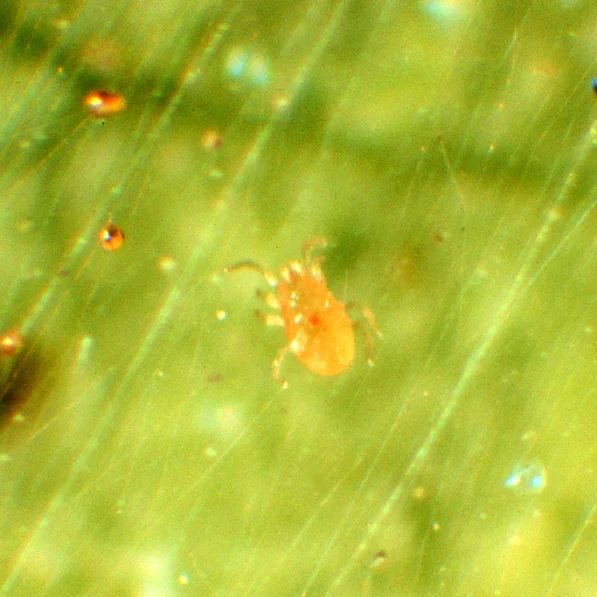
Phytoseiulus persimilis is a specialist predator, it feeds exclusively on tetranychid spider mites, with Tetranychus urticae as its primary prey. Adults are 0.02-0.03 inches, pear-shaped, bright orange-red, and significantly more active than the pale green pest mites they hunt. Egg-to-adult development requires approximately 7 days at 80°F; adults consume 5-20 mite eggs or 2-5 mobile mites per day. Because its development rate exceeds that of T. urticae under warm conditions, P. persimilis can collapse a mite outbreak faster than most miticide treatments.
Native region: Not native to Tennessee; originally from the Mediterranean region, widely distributed through commercial release and incidental introduction in the eastern United States.
Phytoseiulus persimilis is commercially available for augmentative release on ornamental shrubs, strawberries, and greenhouse crops in Middle Tennessee. Its effectiveness depends on relative humidity above 60%, a condition that the zone's subtropical summers generally provide. At temperatures above 90°F or below 60% humidity, reproduction slows and control diminishes; under these conditions, the more heat-tolerant Neoseiulus californicus is a better option. Conventional miticides (bifenthrin, abamectin at high rates, hexythiazox) are lethal to P. persimilis; selective chemistries such as spiromesifen or low-rate abamectin have substantially less impact and are compatible with augmentative releases.
Quick Facts
- Common Name
- Predatory Mite
- Scientific Name
- Phytoseiulus persimilis
- Category
- Beneficial Insect
- Region
- Middle Tennessee