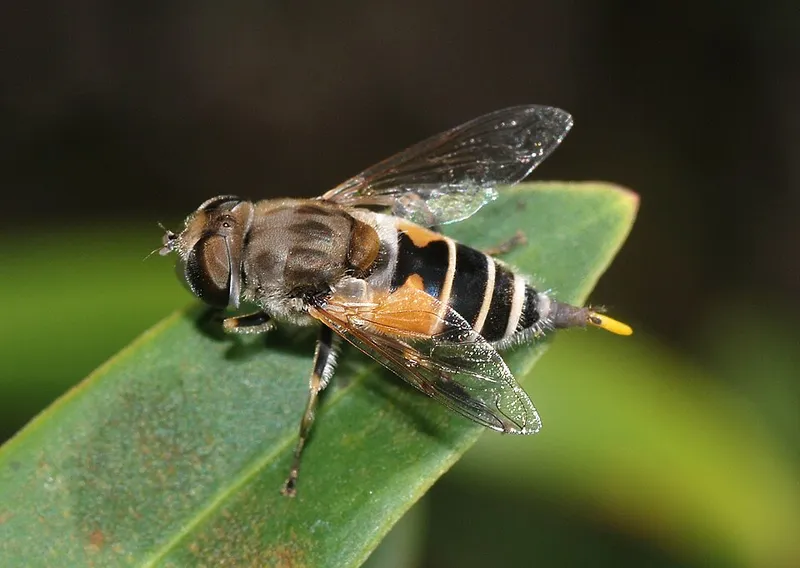
About Hoverfly
Hoverfly (Toxomerus spp.)
Flower Flies, Syrphid Flies
Found on open flowers in gardens, meadow edges, and turf borders; adults hover in stationary flight or dart rapidly between blooms; most abundant in spring and early summer.
Toxomerus is one of the most species-rich genera in family Syrphidae in eastern North America. Adults are 0.3-0.5 inches, yellow-and-black banded, and often mistaken for wasps or small bees, a case of Batesian mimicry. Adults are important pollinators of small-flowered plants. Larvae of many Toxomerus species are predatory on aphids, consuming dozens of aphids per day while crawling within the aphid colony; other species are fungivorous or detritivorous.
Native region: Multiple Toxomerus species are native throughout Tennessee; adults most visible on umbellifers and composites in bloom.
In Middle Tennessee, Toxomerus adults are frequently observed hovering over lawn edges and ornamental beds in April and May. Their aphid-predatory larvae are visually similar to green lacewing larvae, elongated, legless, and translucent, and are found directly within aphid colonies on rose stems, crape myrtle suckers, and ornamental grasses. Because Toxomerus adults require nectar and pollen for egg maturation, landscapes with a diversity of flowering plants across the season (especially umbellifers such as dill and Queen Anne's lace) maintain much higher hoverfly populations than monoculture turf with ornamental beds alone. Pyrethroids applied as foliar sprays during bloom periods are directly lethal to adults foraging on flowers.
Quick Facts
- Common Name
- Hoverfly
- Scientific Name
- Toxomerus spp.
- Category
- Beneficial Insect
- Region
- Middle Tennessee