There are three certification levels and most people have only ever seen the weakest one. The white tag on every bag is federal law, a statement of contents rather than a standard of quality. A blue tag means a land grant university pulled samples, verified the cultivar, and held it to thresholds for noxious weed, other crop, and weed seed. Gold tag, Sod Quality Certified, is what I buy: roughly six times the sample size, zero tolerance on noxious weeds, field inspections through the growing year, and third party inspection every time the seed changes containers. I call 70 to 80 growers a year to build a blend out of it.
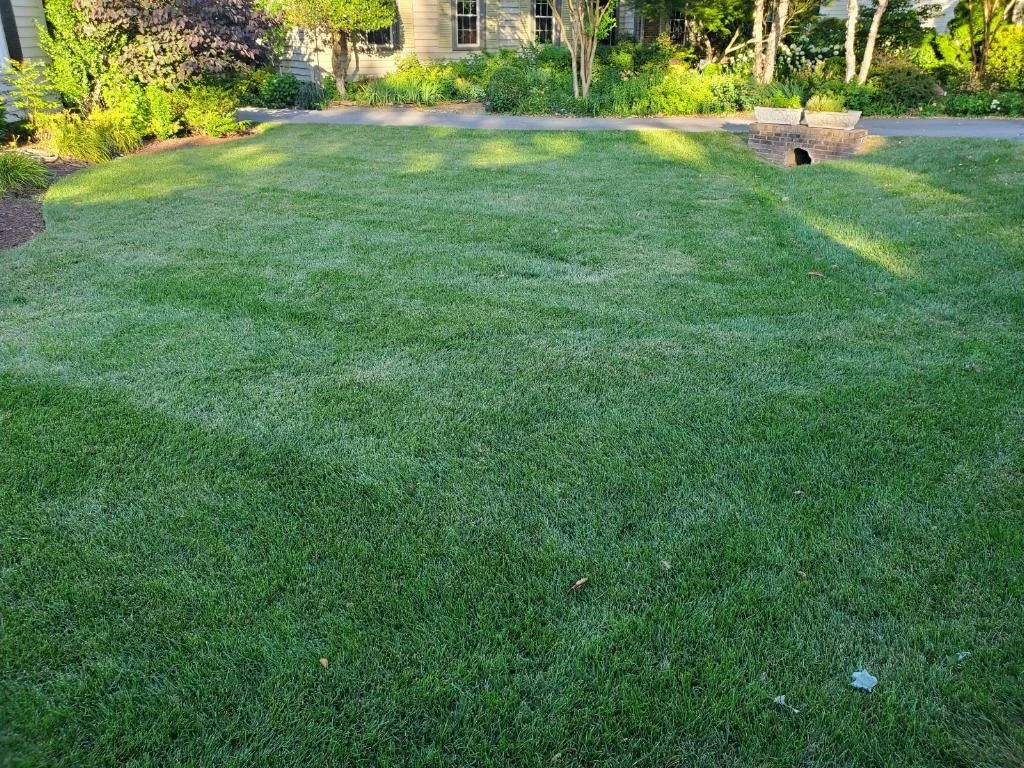
What is in my bag right now is three turf-type tall fescues, Traverse 2 SRP, 4th Millennium SRP, and Triad, with Barvette HGT Kentucky bluegrass as the ten percent. All three fescues sit on UT Extension's list of statistically top-performing tall fescues for Tennessee (NTEP trials), and I chose them for rhizomatous self repair, brown patch resistance, and traffic recovery. Barvette HGT is the one worth pointing at. It establishes unusually fast for a bluegrass, its rhizomes are what knit the whole stand together, and it came out of Barenbrug's Healthy Grass Technology program, which stress tests for exactly the transition-zone persistence a Williamson County summer demands.
That sounds like fuss until you price cheap seed honestly. Kentucky 31 is the cheapest fescue on the shelf, and the price traces straight back to the standard of care in the production field, where whatever the grower could not control gets harvested along with the crop. Dallisgrass, Paspalum dilatatum, is the one that costs people. Oregon seed testing classifies it as other crop seed rather than a weed, so it carries a higher allowable threshold. You plant it in October, see nothing all winter, and meet it the next July as a coarse clump with straight blades that takes me three to five years to clear. Johnson grass and quackgrass ride in the same way, and straw used as a cover is worse than any of them.