UT Certified Lawn Care Professional Tennessee Turfgrass Association Member Turfgrass Water Conservation Alliance Member Nextdoor Neighborhood Favorite BBB A+ Accredited
Why the Last Week of August Beats October for Fescue Seeding in Middle Tennessee
Seasonal Care

Why the Last Week of August Beats October for Fescue Seeding in Middle Tennessee

By AJ Binkley, UT Certified Lawn Care Professional

Every August I have some version of the same conversation. A homeowner in Columbia or Spring Hill looks at the ten-day forecast, sees highs in the low nineties, and tells me they would rather wait until October to seed, when it is cool, when it rains, when it feels like grass weather. I understand the instinct completely. It is also the single most expensive mistake you can make with a fall seeding.

Here is the part that flips it around: the seed does not care what the weather is like the day you put it down. It cares what the weather is like about four weeks later.

A Fescue Seed Carries Its Own Lunch

Do this yourself if you do not believe me. Take a single tall fescue seed, wrap it in a wet paper towel, seal it in a sandwich bag, and shove it in a dark kitchen drawer. No soil. No fertilizer. No sunlight. Come back in a couple of weeks and you will find a white shoot three or four inches long.

Where did that come from? The endosperm, the starchy reserve packed inside the seed pod. That reserve is a full set of groceries for a brand new plant. Germination and the first weeks of growth do not require favorable conditions, sunlight, or a nutrient-rich seedbed. They require moisture and nothing else.

Which means the heat you are worried about in the last week of August is not the enemy you think it is. A seed will germinate in a hot Middle Tennessee lawn just fine as long as it stays damp. What it cannot do is survive the moment its lunch runs out with nothing to eat.

The Appointment That Actually Matters Is Four Weeks Out

That endosperm reserve is finite. Somewhere around four weeks after germination, the seedling burns through it and has to start making its own living, photosynthesis, root uptake, real nutrient acquisition from real soil. That is the moment the plant becomes vulnerable, and that is the moment you want cool nights, shorter days, dew, and September rainfall waiting for it.

So run the calendar backward instead of forward. Seed in the last week of August and the reserve runs out right as our best growing conditions arrive. The seedling steps out of the seed pod and straight into ideal weather. Seed in October and the reserve runs out in November, when soil temperatures are dropping and daylight is disappearing, and the plant has to establish itself on a shrinking budget.

Same seed. Same lawn. Same seeding rate. Completely different outcome, decided by a calendar.

Three to Six Weeks Is Not a Rounding Error

The gap between a late-August seeding and an October seeding is roughly three to six weeks of active growth. On a mature lawn that sounds trivial. On a seedling it is most of its life.

In those weeks a tall fescue seedling goes from a single wispy blade to a plant with multiple tillers, a crown that sits at the right depth, and a root system deep enough to find water on its own. That is the difference between something that shrugs off the first hard frost and something that gets heaved out of the soil by it.

People also forget that seed does not sprout the day you spread it. Under absolutely ideal conditions, soaking wet, fully shaded, you are looking at five days minimum. In the real world it is seven to fourteen days before you see anything green. So if you wait for the perfect weather window and seed on the first cool rainy day of October, you have already given away one to two weeks of that window before a single blade emerges.

Add my own scheduling to that. I book the fall aeration route through August, and once it is set the season is largely spoken for. If everyone in Maury and Williamson County decides the same October Tuesday is the day, most of them are not getting seeded that Tuesday, they are waiting on whatever gaps open up. Being two days late does not sound like much until you realize you are subtracting from a window that was already too short.

What UT Extension Says, and Why I Bring It Up

I do not ask anyone to take this on my word alone. I am a UT Certified Lawn Care Professional, and the university that certified me publishes its recommendations openly.

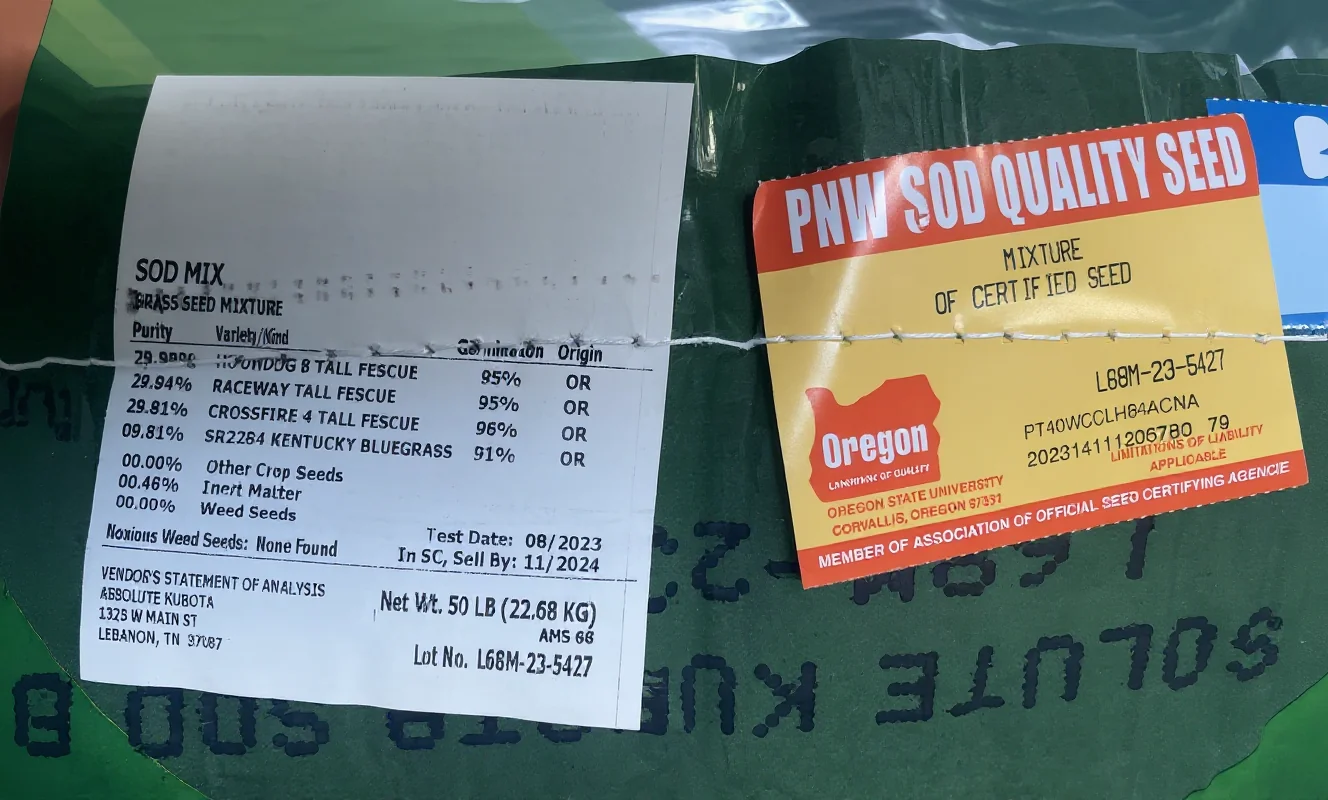
UT Extension publication PB 1576, Selecting, Establishing and Maintaining the Fescues, and W 160-F, When to Plant Turfgrasses, both put the preferred fescue seeding window at late August through mid-September. Both warn that late-seeded plants go into winter immature and are more prone to low-temperature stress.

Read those two sentences again, because they are the whole argument. The preferred window opens in late August, not October. And the specific failure mode of seeding late is not that the seed will not sprout. It is that the plant will not be grown up enough by the time cold weather arrives.

October seedings are not a disaster. I do plenty of them, and they work. September beats October, and late August beats September. If you have a choice about when to get on the schedule, take the earlier slot.

An Early Canopy Is Also Your Poa Annua Defense

There is a weed benefit here that almost nobody connects to seeding timing. Annual bluegrass, Poa annua, germinates in the September through November window, and it needs three things: bare soil, some mechanical pressure on that soil, and that fall timing. The seed bank is functionally permanent. You are never getting it out of your yard.

What you can do is take away the bare soil. If there is a living canopy of grass covering the ground in September and October, sunlight never reaches the seedbed and Poa annua largely does not happen. A lawn seeded in late August has a canopy by then. A lawn seeded in mid-October is bare dirt during the exact weeks annual bluegrass is looking for a home, and you have handed it a seedbed you prepared yourself. Same story for the tire-track strip along a curved driveway where somebody cuts the corner.

This Fall Decides What Survives Next Summer

Here is the thing I most want homeowners in the I-65 corridor to internalize. Fall is not the season where you fix last summer. Fall is the season where you determine next summer.

Middle Tennessee sits in the transition zone, which is a polite way of saying we get real winter and real subtropical summer in the same yard. Between the humidity, the dew that keeps blades wet up to twelve hours a day, and nighttime temperatures above 75 degrees, brown patch (Rhizoctonia solani) and dollar spot are not questions of if. They are questions of when, and gray leaf spot has been getting worse here every year, arriving right at the end of August when nobody expects it.

A plant that entered winter mature, deeply rooted, and fully tillered has resources to spend on that fight. A plant that entered winter as a two-month-old seedling does not. It spends July fighting for its life instead of growing, and by August it is one of the thin spots you are calling me about.

That is why I offer aeration and overseeding to every customer in late summer, scheduled around the early fall treatment, and why the aeration is always paired with seed and liquid aeration rather than sold as a standalone. The core aerator is not there to fix your soil. It is there to guarantee seed-to-soil contact so the stand you establish this fall is thick enough to carry you through next July.

Look at your yard right now. Do you have enough grass where you want grass? If the answer is yes, congratulations, skip it this year and save your money. If the answer is no, do not wait for October. Get on the calendar while the last week of August is still on it.

fall seedingfescueoverseedingseeding timingmiddle tennessee

Related Articles

Ready for Professional Lawn Care?

Stop guessing and start growing. Get a free quote from our UT Certified lawn care team today.