About Black Turpentine Beetle
Black Turpentine Beetle
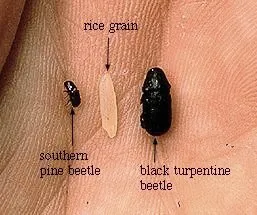
Identification: The largest of the southern pine bark beetles: adults 5-8 mm, black to dark brown with a stout, cylindrical body. The rounded, unarmed posterior immediately distinguishes it from Ips species. Attacks are concentrated on the lower 2 meters of the trunk and major root flares, this low-trunk attack zone is the most reliable field distinguishing feature. Pitch tubes at the base of pine trunks are large (20-40 mm diameter) and creamy-white to pink, significantly larger than the pitch tubes of southern pine beetle or Ips.
Life cycle: One to two generations per year in Tennessee. Adults fly April through October, with peak activity May-June. Unlike aggregating species, black turpentine beetle attacks are more diffuse, single pairs attack individual pitch-tube sites without the mass-attack pheromone recruitment used by southern pine beetle. Larvae feed in broad, irregular group galleries in the inner bark and sapwood, creating large patches of dead cambium at each attack site. The full development cycle is 3-5 months.
Damage signs: Large pitch tubes clustered on the lower 2 m of the trunk and root flares. Trees can tolerate moderate numbers of attacks (fewer than 10-15 active pitch tubes) and continue to pitch out successfully. Excessive attacks, particularly on stressed trees, overwhelm the pitch defense and cause progressive crown decline beginning 3-6 months after initial attack. Loblolly, shortleaf, and Virginia pine in recently disturbed soil, from root trenching, grade changes, or droughty urban sites, are primary targets.
Treatment window: Before attack in high-risk situations (root disturbance, construction near drip line, drought). The window for preventing new attacks on adjacent pines extends through the full flight period April-October.
UT-recommended approach: Minimize root disturbance within the drip line of landscape pines, root zone injury is the leading predisposing factor. Maintain soil moisture under specimen pines during drought periods. Preventive carbaryl or permethrin applied to the lower trunk and root flare prior to anticipated attack periods reduces establishment on high-value trees.
Quick Facts
- Common Name
- Black Turpentine Beetle
- Scientific Name
- N/A
- Category
- Landscape Pest
- Region
- Middle Tennessee