Why Any of This Matters on a Fescue Lawn
If your Middle Tennessee lawn is fescue, it is a cool-season lawn, and it holds its color through our winter on its own. There is no dormant brown base for ryegrass to cover up. There is nothing for a winter overseed to accomplish.
What you would actually get is a second species competing with your fescue for water, light, and nutrients all spring, then dying in the first real heat and leaving the stand thinner than it started. That is not a hypothetical failure mode. It is the same mechanism that makes builder-seeded lawns disappointing. Contractor mix is cheap fescue cut with annual ryegrass so the yard flashes green for the final walkthrough, which means a new construction lawn is an overseeded lawn from the day it is planted, and the ryegrass half was always designed to leave.
So when somebody offers to overseed your fescue lawn with ryegrass for winter color, they are running a Bermuda playbook on a cool-season yard. It is not a scam. It is a category error, and it costs you a season of density you cannot get back until next fall.
The Sod Wrinkle That Puts Most Lawns in Both Categories
Now the part that made me want to write this down, because my own service does not land cleanly in one bucket, and I am not going to pretend it does.
What gets sold as fescue sod is not pure fescue. Sod farms grow it as a tall fescue and Kentucky bluegrass (Poa pratensis) blend, because bluegrass rhizomes are the structural element holding a sod roll together while it gets cut, rolled, hauled, and unrolled. I have laid out the full case for that mixture elsewhere. The fact that matters here is simpler: a sodded fescue lawn already contains two species, and they are the same two species in my bag.
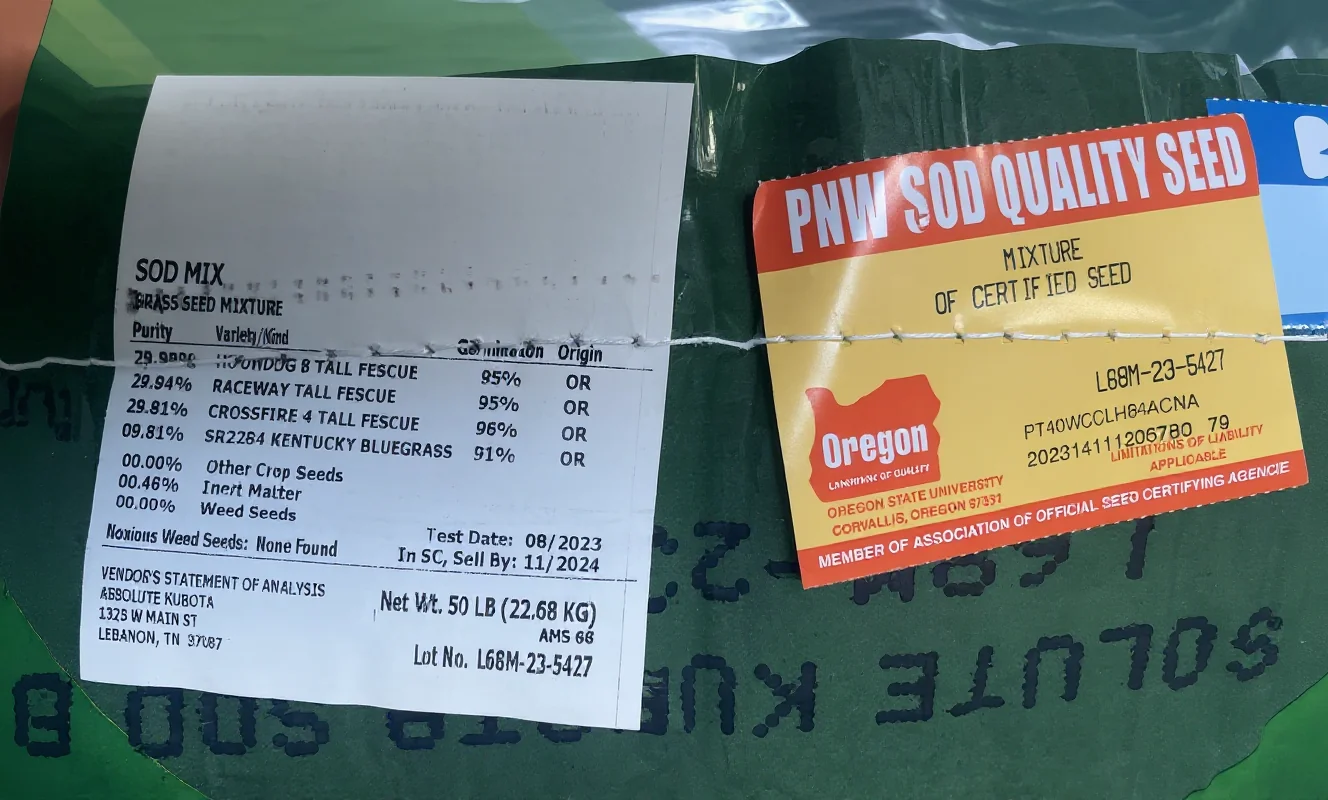
My blend runs 90 percent turf-type tall fescue to 10 percent Kentucky bluegrass by weight, and I publish the cultivar names rather than calling it premium and moving on. So the honest answer to what I am doing to your lawn depends on how your lawn started.
- Lawn established from sod. What I do is true interseeding on both counts. Same fescue, same bluegrass, no new species entering the yard. You get a seamless blend instead of a visible patch where the new seed went in.
- Lawn established from seed as pure fescue. My mix is interseeding for the fescue fraction and overseeding for the bluegrass fraction, simultaneously. It is a combination, and I would rather use both words correctly than pick whichever one sounds cleaner in a sales conversation.
One more thing about that second case, because it turns the definition inside out. The overseeded fraction is permanent by design. That bluegrass is in the bag to knit the stand together for good, to close a zero-turn divot or the bare strip where somebody parked on the grass, on its own, without me. It is overseeding by the taxonomy and interseeding by intent, and there is no single word for that.
The Question to Ask
You do not need to memorize any of this. You need one question for whoever is quoting your fall work.
Is the seed you are putting down the same species already in my lawn, and is it supposed to still be alive next August?
If they answer that without stalling, they know what they are selling you. If the answer names a species you do not currently have and it is not meant to survive the summer, that is overseeding, and you are owed a reason your lawn needs it. If they cannot name the species at all, vocabulary is the smaller of your problems, and the seed tag is the next thing I would go look at.
When I run aeration and seeding, the same mix goes down in Franklin as in Columbia as in Spring Hill, metered through a drop seeder built into the aerator so it lands in open holes instead of blowing into the flower beds. Whether that is interseeding or a combination on your specific yard depends on whether a sod truck or a seed bag started it, and I am happy to tell you which one you have while I am standing in it.