UT Certified Lawn Care Professional Tennessee Turfgrass Association Member Turfgrass Water Conservation Alliance Member Nextdoor Neighborhood Favorite BBB A+ Accredited
I Will Tell You Exactly What Is in My Seed Bag
Lawn Health

I Will Tell You Exactly What Is in My Seed Bag

By AJ Binkley, UT Certified Lawn Care Professional

Ask a lawn company what seed they put down and listen carefully to the answer. Almost every time you get an adjective. Premium. Elite. Professional grade. Our proprietary blend. What you do not get is a name, because a name can be looked up, and looking it up is exactly what nobody wants you doing.

So here is mine in writing.

My mix is three turf-type tall fescues, Traverse 2 SRP, 4th Millennium SRP, and Triad, carrying a Kentucky bluegrass fraction of Barvette HGT from Barenbrug. It runs about 90 percent fescue to 10 percent bluegrass by weight, and I buy it as Sod Quality Certified, Gold Tag seed. Every one of those names is public. Every one of them has trial data behind it that you can pull up on your phone while I am standing in your yard. That is the point.

The Tag Is the Whole Argument

Before the cultivars, understand what you are looking for, because this is a thing you can check on any bag of seed anybody ever sells you.

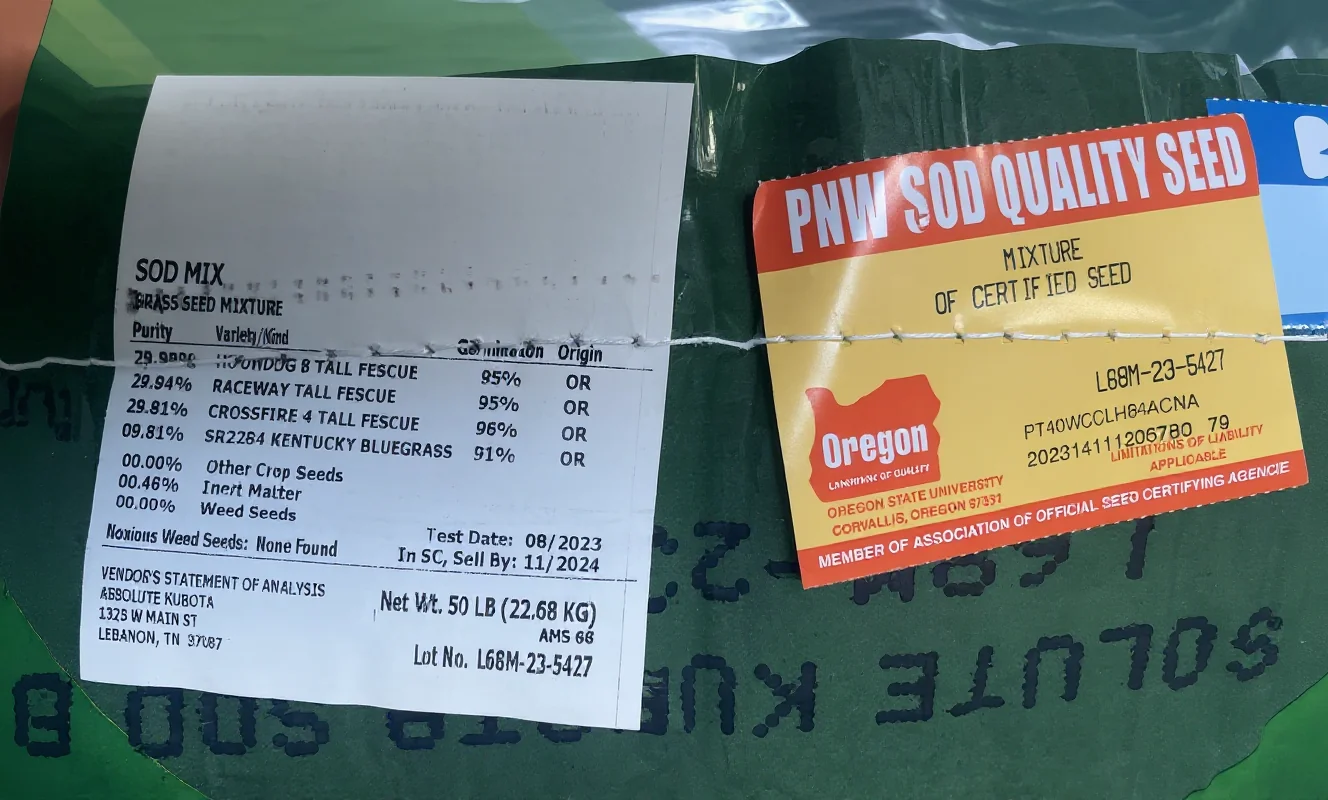
The tag stitched or glued to a bag of grass seed is not marketing copy. It is a legal document under state seed law, and it has to tell you the variety names, the purity percentage, the germination percentage, the test date, and how much inert matter, other crop seed, weed seed, and noxious weed seed came along for the ride.

Now go look at a bag off a big box shelf. In the variety column you will very often find three words: Variety Not Stated. VNS. That is not an oversight or a printing shortcut. It means the seller either does not know or will not say what plant is in there, which in practice means it is whatever was cheapest at the time of blending. You are buying genetics blind.

A Gold Tag, Sod Quality Certified bag cannot do that. It has to name the varieties, and it is held to the tightest contamination thresholds in the seed trade. That matters here more than most places, because cheap seed is how dallisgrass and Johnson grass get into Middle Tennessee lawns in the first place, riding in as other crop seed on a tag nobody read.

If you take nothing else from this article, take that. Read the tag. If the tag will not name the plant, do not buy the bag.

Traverse 2 SRP

The SRP on the end stands for self-repairing, and it is not decoration. Traverse 2 produces rhizomes, which is the trait tall fescue is famous for barely having. I have written before about how fescue does not meaningfully knit itself back together after damage, and that is still true of the species as a whole. But breeders have been selecting for rhizome production in tall fescue for twenty years now, and the SRP line is what that work produced. It does not turn fescue into bluegrass. It moves the needle.

The producer, Turf Merchants, lists it as compact, dense, drought tolerant, fine leafed, with improved brown patch resistance and traffic stress resistance demonstrated in NTEP trials. It was rated highest for turf quality among tall fescues in two separate NTEP breakouts, including the Transition Region group, which is the only breakout that describes the climate you and I actually live in.

Brown patch (Rhizoctonia solani) resistance is the trait I weight hardest in a fescue for this region, and I have explained why elsewhere: subtropical humidity, blades wet up to twelve hours a day off dew alone, and nights above 75 degrees. Genetics is the cheapest disease control there is.

4th Millennium SRP

This is the one that would win an argument in a bar. In a national trial of 116 varieties, 4th Millennium SRP scored the highest of all of them in overall turf quality, and also scored high for establishment, density, and texture. Not top ten. Not top statistical group. Highest, out of a hundred and sixteen.

Like Traverse 2 it carries rhizomes for self-repair, which speeds establishment and improves recovery from damage. It resists brown patch. It was rated highest for turfgrass quality in NTEP's Transition Region trial and in the LPI Group 1 trial, and it held up in the percent canopy fullness ratings under both traffic and no traffic conditions.

Here is the detail that made me smile the first time I read the producer's own spec sheet, because it is my entire mix architecture written by somebody else: 4th Millennium SRP mixes well with 5 to 10 percent Kentucky bluegrass. I landed at 10 percent by weight from NTEP data and from watching lawns in Maury and Williamson County for years. The people who bred the plant say the same number.

Triad

Triad, entered in NTEP as PPG-TF 323, is the color in the bag. It is an extremely dark green fescue, and it earns high NTEP marks across an unusually wide range of categories rather than spiking in one.

What it brings that the other two do not is gray leaf spot resistance alongside brown patch resistance, plus traffic stress recovery and wear tolerance. Gray leaf spot (Pyricularia grisea) is the fall disease people around here misdiagnose as drought stress, and it hits new seedlings hardest, which is exactly the population I am creating every September. Putting a cultivar in the bag that resists the disease the seedlings are about to meet is not a luxury.

What UT Extension Says About These Three

I do not expect you to take a lawn guy's word for cultivar selection, and you should not have to.

All three of my fescues appear on UT Extension's list of statistically top-performing tall fescues for Tennessee, drawn from NTEP trial data. That list runs in the Timely Turfgrass Memo, Fall 2024, published by Dr. Becky Bowling, Assistant Professor and Extension Turfgrass Specialist at the University of Tennessee. 4th Millennium SRP and Traverse 2 SRP come off the 2012 trial list, Triad off the 2018 trial list.

I want to be precise about what that is and is not, because this industry is full of people implying more than they have. It is not an approved list. It is not a certification. Nobody at UT endorses my company or my bag. It is a statistical statement: across the trial data, these varieties performed in the top group for Tennessee, and the differences between them and the rest were not noise.

The same memo does one more thing worth repeating. It tells consumers to buy from seed producers, Barenbrug named among them, rather than off big box shelves. That is a state land-grant turf specialist telling homeowners the same thing I have been telling customers, and it costs me nothing to point at it.

One note so nobody accuses me of cherry picking: that memo also carries UT's general planting window guidance, and my own position on timing is more aggressive than theirs. I put seed down the last week of August, and I have written out the seed reserve reasoning behind that in full. Take the cultivar list from UT. The calendar is my call, and I will defend it separately.

Barvette HGT, the Ten Percent That Does More Than Ten Percent of the Work

Now the bluegrass, and this is the part of the bag I get genuinely interested in.

Kentucky bluegrass (Poa pratensis) is in my mix because it is aggressively rhizomatous in the way fescue is not. Its rhizomes run far enough to physically knit a stand together, which means a divot from a zero-turn or the bare strip where somebody parked on the grass closes on its own instead of waiting for me to come reseed it. That is the self-repair layer. Fescue is the body of the lawn. Bluegrass is what keeps the body from developing holes.

But bluegrass in the transition zone has always come with a bill attached, and the bill is summer patch (Magnaporthe poae), a root rot that takes bluegrass apart in exactly the hot, humid, wet-rooted conditions Middle Tennessee produces every July. Historically that is the reason people here treat bluegrass as a northern grass that does not belong in the bag.

Barvette HGT is Barenbrug's answer to that specific problem, and the record on it is unusually clean.

  • It was bred under stress on purpose. Barenbrug's Healthy Grass Technology program selected it from exceptionally traffic-tolerant parent stock and evaluated thousands of plants under harsh climatic conditions, rather than breeding for looks in an easy nursery and hoping the plant survives the field.
  • It won the transition zone. In the 2005 to 2010 Kentucky bluegrass NTEP trials, Barvette HGT, entered as BAR VV 0709, was the top turf quality entry in the transition zone region, and the reason given is its summer patch tolerance. That is the exact disease that disqualifies most bluegrass from a Tennessee bag, and this one won the region because of how it handles it.
  • It is not a one-trait plant. Across those same NTEP trials it ranked number one or in the top statistical group in 16 different performance traits. In a 2010 Michigan State study of 109 commercial varieties and experimentals, it was the top rated entry for wear recovery, percent ground covered, and turf quality. It also showed excellent stand persistence and very good stem rust tolerance in the Stillwater, Oklahoma trial location.
  • It establishes fast for a bluegrass. Bluegrass is notoriously slow out of the ground compared to fescue, which is a real practical problem when you are seeding both together and want them to come up as one stand. Barenbrug's producers put HGT germination at as few as seven days depending on weather. On a fall seeding where fescue is up in seven to fourteen, that closes the gap enough that the lawn fills in evenly instead of coming in fescue first and bluegrass a month behind.

I want to be careful here, because I am aware that section reads like a brochure and I do not write brochures. So let me put the honest frame on it. Those are trial results and producer specifications, not my field data, and vendors publish their good numbers. What I can tell you from my side is why I went looking for a plant like that in the first place: I wanted the repair mechanism bluegrass provides without importing the disease bluegrass usually brings, and one plant kept coming up in the transition zone data. Facts are the flex. I did not have to embellish any of that, which is more than most seed pitches can say.

Why Any of This Is Worth Your Attention

Here is the practical stake, and it is money, not vanity.

A transition-zone fescue lawn running old genetics needs reseeding every single year. A lawn built from modern improved cultivars averages about every three years. Same climate, same homeowner, same mower, different plant. That is a two-thirds cut in how often you write this check, and it is decided one time, at the bag.

Which is the whole problem with contractor mix and commodity seed. If a builder seeded your lawn, or you bought whatever was stacked by the register, you almost certainly got old cheap tall fescue, frequently Kentucky 31, which is the oldest cultivar in the category and scores poorly across NTEP on disease, texture, quality, and color. Often it is cut with annual ryegrass so it flashes green fast, which is a fine goal for erosion control on a construction site and a terrible one for a lawn you intend to keep. The contractor gets paid at the final walkthrough. Nobody scores them on what your yard looks like the following July.

So that lawn starts life on the annual reseed clock before you have made a single decision about it, carrying contaminants you did not order, and every year you spend money to stay in place. Upgrading the genetics is what gets you off that treadmill. It is not a cosmetic upgrade, it is a change in operating cost.

What to Do With This

Go find your seed tag if you still have the bag, or ask whoever seeded your lawn for the variety names in writing. If you get four names and a certification tag back, good, you are in decent shape regardless of who put it down. If you get an adjective, or VNS, now you know what you are actually standing on and why the lawn behaves the way it does.

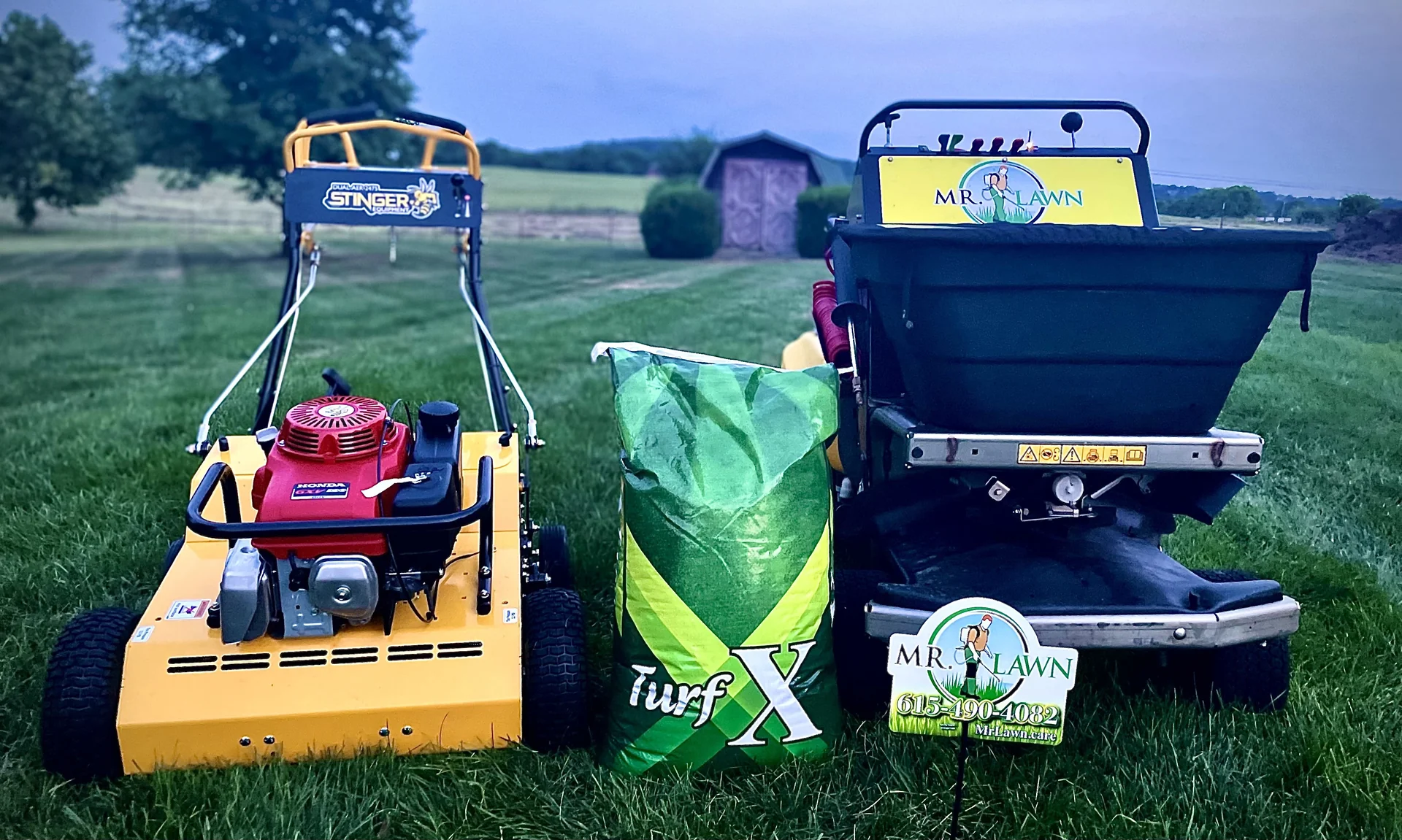
When I run aeration and overseeding, this mix is what goes down, metered through a drop seeder built into the aerator so it lands in open holes instead of blowing into the flower beds. Same four cultivars in Columbia as in Franklin, as in Spring Hill. I am not running a cheap bag on price-sensitive yards and a good bag on the ones that ask questions.

You are welcome to check every claim in this article before you hire me. Honestly, I would rather you did.


Sources

seed geneticstall fescuekentucky bluegrassoverseedingtransition zone

Related Articles

Ready for Professional Lawn Care?

Stop guessing and start growing. Get a free quote from our UT Certified lawn care team today.