About Spongy Moth
Spongy Moth
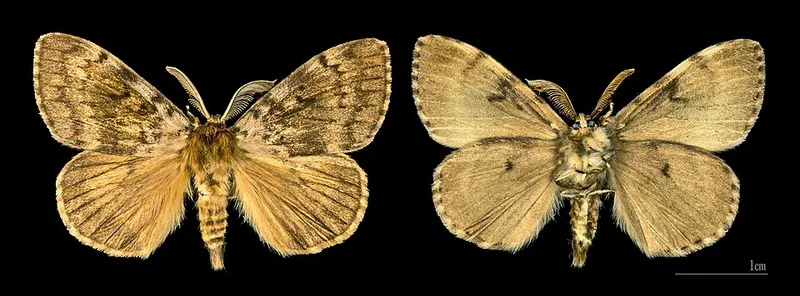
Identification: Lymantria dispar (formerly gypsy moth), larvae are the damaging stage: up to 60 mm when mature, hairy, with five pairs of blue dots and six pairs of red dots along the back. Males are brown with wavy dark bands; females are larger, white with dark markings, and flightless. Egg masses are tan, spongy, 25-40 mm, laid on bark, outdoor furniture, vehicles, and structures. The species was officially renamed "spongy moth" in 2022 to replace a historically offensive common name.
Life cycle: One generation per year. Egg masses overwinter on any firm surface; eggs hatch in late March to April in Middle Tennessee's climate. Young larvae balloon on silk threads and are dispersed by wind. Larvae feed through May-June; pupation occurs in late June-July. Adults emerge in July-August; females lay egg masses and die. The egg-mass stage is the primary pathway for human-assisted spread on vehicles and camping gear.
Damage signs: Defoliation, larvae consume foliage of a wide host range, with oak (Quercus spp.) and aspen as preferred hosts, but also attacking beech, birch, sweetgum, and many others. A single defoliation event rarely kills healthy trees; repeated defoliation combined with secondary stressors (drought, other pests) leads to tree mortality. Outbreak populations in Middle Tennessee are currently sporadic, the pest is established in parts of Tennessee but population irruptions vary by location.
Treatment window: At egg hatch in late March to early April, through the small larval stage (instars 1-3). Older larvae are harder to kill and have already consumed most seasonal foliage.
UT-recommended approach: Bacillus thuringiensis var. kurstaki (Btk) applied at egg hatch targets early instars with no impact on non-lepidopteran organisms. Diflubenzuron (Dimilin) is used for aerial application in outbreak situations. Egg mass removal and destruction in fall and winter prevents the next generation. Report suspected egg masses on vehicles after travel to infested areas, early detection slows the spread front in Middle Tennessee.
Quick Facts
- Common Name
- Spongy Moth
- Scientific Name
- N/A
- Category
- Landscape Pest
- Region
- Middle Tennessee