About Rose Sawfly
Rose Sawfly (Arge ochracea)
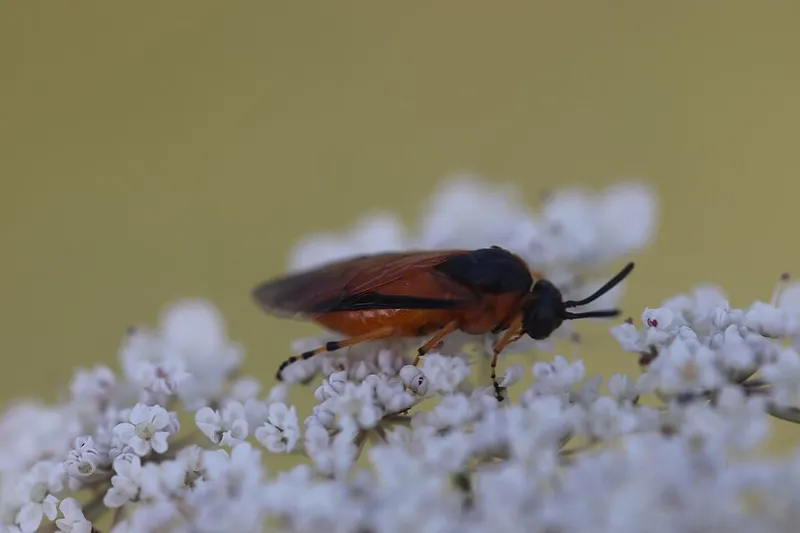
Identification: Arge ochracea is one of several sawfly species attacking roses in Tennessee; Arge pectoralis (bristly rose slug) is a closely related co-occurring species. Larvae of A. ochracea are pale green to yellowish with a dark head, 15-20 mm at maturity, feeding gregariously on leaf margins and surfaces. Adults are 8-12 mm, stout-bodied Hymenoptera with a yellow-orange abdomen and dark head and thorax. The wasp-like adult lacks a constricted waist, distinguishing sawflies from true wasps. The gregarious feeding behavior of young larvae and host specificity to Rosa spp. are the primary field identification characteristics.
Life cycle: Two to three generations per year in Tennessee. Overwinters as pupae in the soil or stems beneath rose canes. Adults emerge in spring, and females use the serrated ovipositor to insert eggs into rose stem tissue (the oviposition wounds appear as raised ridges on young canes). Larvae hatch and feed gregariously, initially skeletonizing leaf undersides before progressing to full consumption of leaf tissue. Mature larvae drop to soil to pupate. Subsequent generations are present in July and again in September.
Damage signs: Skeletonized rose leaves, upper epidermis intact, leaf tissue consumed, from early-instar gregarious feeding. Older larvae consume entire leaf blades leaving only the midrib. Characteristic oviposition scars (raised linear ridges) on young rose canes are a diagnostic early sign. Roses in full sun, which are the preferred growing condition for most ornamental varieties, consistently support larger populations. In Middle Tennessee, rose sawfly pressure from May through September is consistent on unprotected hybrid teas and shrub roses.
Treatment window: At egg hatch in late April to May when larvae are small and gregarious. Second window in July for the second generation.
UT-recommended approach: Hand-removal of larval colonies by clipping and destroying infested shoots is practical and effective on specimen and small garden roses. Spinosad or insecticidal soap applied to leaf surfaces at first sign of skeletonizing targets young instars. Note that sawflies (Hymenoptera) are not susceptible to Btk, do not use Btk for rose sawfly management. Systemic imidacloprid is less effective against sawfly larvae than against sucking pests.
Quick Facts
- Common Name
- Rose Sawfly
- Scientific Name
- Arge ochracea
- Category
- Landscape Pest
- Region
- Middle Tennessee