About Emerald Ash Borer
Emerald Ash Borer (Agrilus planipennis)
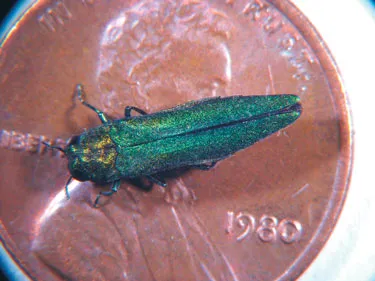
Identification: Adults are 8-14 mm, metallic emerald green, with a flattened, elongated body. The flat-headed larva is cream-colored, up to 30 mm, with a bell-shaped first thoracic segment. Infestations are identified by D-shaped exit holes (3-4 mm wide) in bark, serpentine galleries visible beneath loosened bark, and epicormic sprouting from the trunk base. Splits in bark from woodpecker foraging (blonding) are an early field sign. Host-specific to ash (Fraxinus spp.) only.
Life cycle: Typically one generation per year in Tennessee. Adults emerge May through July, cutting D-shaped exit holes. Females lay eggs singly in bark crevices; larvae bore through the outer bark and feed in the cambium and phloem in S-shaped galleries, girdling the tree. Overwinters as prepupae in the outer sapwood. Trees with moderate infestations may persist 2-3 years before death; heavily infested trees die within 1-2 years.
Damage signs: Canopy dieback beginning at the top of the tree and progressing downward. D-shaped exit holes (not round, this distinguishes EAB from native borers) in bark. Serpentine galleries packed with frass beneath the bark. Epicormic sprouting at the base. Vertical bark splits in older infestations. By the time canopy symptoms appear, infestation is typically well-established. All native ash species in Tennessee are susceptible; white ash (F. americana) and green ash (F. pennsylvanica) are the most common landscape specimens.
Treatment window: Preventive systemic treatments are applied in spring, coinciding with adult emergence (May-July), or as a soil drench before infestation is detected in high-risk areas. Curative treatments are effective only on trees with less than 50% canopy dieback.
UT-recommended approach: Emamectin benzoate trunk injection is the most effective curative and preventive treatment, applied every two years by a licensed applicator. Imidacloprid basal bark spray or soil drench provides preventive protection on smaller-diameter trees. Untreated ash trees in infested areas of Middle Tennessee should be evaluated for removal before structural failure creates a hazard, EAB-killed ash become extremely brittle within two years of death.
Quick Facts
- Common Name
- Emerald Ash Borer
- Scientific Name
- Agrilus planipennis
- Category
- Landscape Pest
- Region
- Middle Tennessee