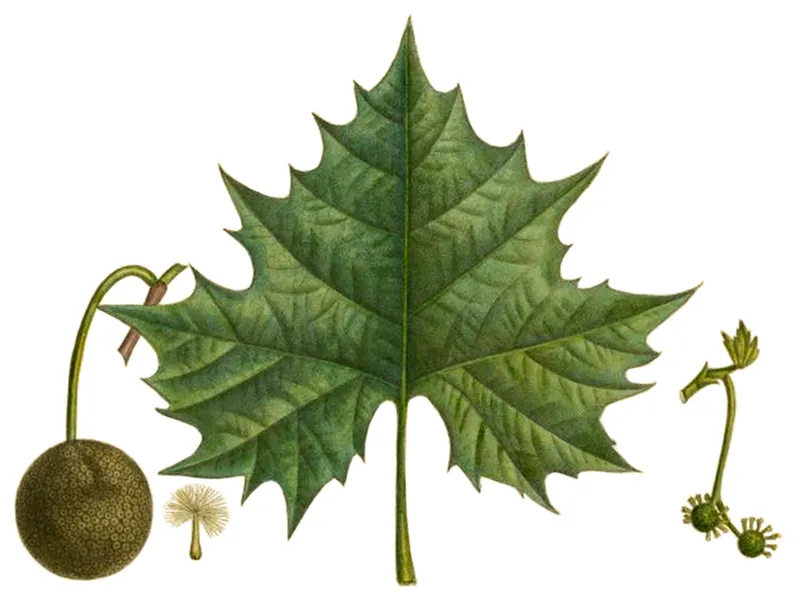
About American Sycamore
American Sycamore (Platanus occidentalis)
Sycamore, American Planetree, Buttonwood
Full sun to light shade, wet to medium moisture, grows in rich loam, silt loam, and clay along water; slightly acid to neutral pH 5.5-7.5; tolerates periodic flooding.
75-100 feet tall by 50-70 feet wide; one of the largest-diameter hardwoods in eastern North America; exfoliating white, tan, and olive-green bark in distinctive camouflage pattern; inconspicuous flowers in spring; round, bristly 2.5 cm seed balls persisting into winter. Growth rate fast.
Native region: Statewide in Tennessee along rivers, streams, and bottomlands; abundant along the Duck River and its tributaries throughout Maury County.
P. occidentalis is immediately recognizable by its exfoliating bark exposing chalky white upper branches, a dominant visual element along every significant creek and river in Middle Tennessee. Anthracnose (Apiognomonia veneta) causes severe early-season defoliation in cool, wet springs, leaves, shoots, and small twigs blacken and die, sometimes stripping the crown entirely by late April. Trees typically releaf by June, but repeated annual infections weaken them over time. The London planetree (Platanus × acerifolia) was developed specifically for greater anthracnose resistance and is preferred for urban plantings. The massive root system and leaf litter volume make sycamore unsuitable for small residential lots; it belongs along creek banks and in large, open spaces where its ecological role as a streambank anchor and cavity-nesting tree can be fulfilled.
Quick Facts
- Common Name
- American Sycamore
- Scientific Name
- Platanus occidentalis
- Plant Type
- Tree
- Region
- Middle Tennessee