About Oleander Scale
Oleander Scale
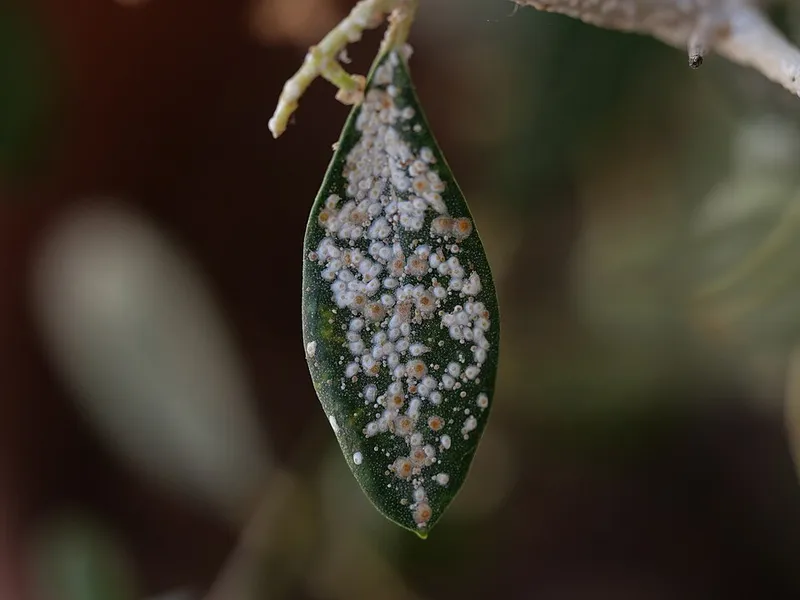
Identification: Aspidiotus nerii · an armored scale (family Diaspididae), 1.5-2 mm diameter, with a flat, circular, white to pale yellow cover. Female covers are slightly larger and more rounded than the elongated male covers. Found on bark, leaves, and fruit of a broad host range: oleander (Nerium oleander), palms, citrus, magnolia, ivy, and many others. The circular white cover distinguishes it from most other armored scales in Tennessee landscapes.
Life cycle: Two to three overlapping generations per year in Middle Tennessee. Overwinters as adults on bark. Crawlers (mobile first instars) emerge in May-June and again in August. Crawlers are yellow, oval, and the only mobile stage, they settle within hours of emergence and begin secreting their protective cover. Females remain sedentary; males are tiny winged adults.
Damage signs: Heavy bark infestations cause yellowing of foliage, reduced vigor, and branch dieback. On oleander, dense scale populations can cover entire stems with white crust. Feeding extracts plant fluids; the armor protects adults from contact insecticides. Sooty mold is less common with armored scales (no honeydew) but infested foliage develops yellow halos at feeding sites.
Treatment window: At crawler emergence in May-June, crawlers lack protective armor and are fully vulnerable to contact insecticides. A second window targets August crawlers. Treating the armored adult stage is largely ineffective with contact materials.
UT-recommended approach: Horticultural oil applied at crawler emergence smothers crawlers before they settle. Systemic imidacloprid soil drench provides uptake-based control across all mobile stages. For small infestations on accessible stems, scrubbing with a stiff brush removes adults mechanically. Monitor crawler emergence with sticky bands wrapped around stems near active infestations.
Quick Facts
- Common Name
- Oleander Scale
- Scientific Name
- N/A
- Category
- Landscape Pest
- Region
- Middle Tennessee