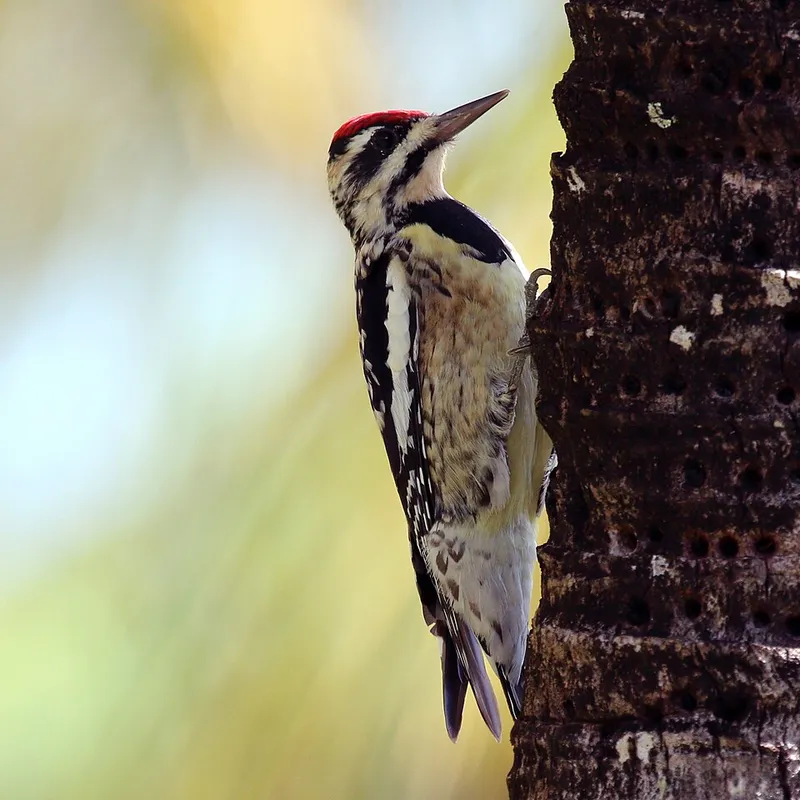
About Yellow-bellied Sapsucker
Yellow-bellied Sapsucker (Sphyrapicus varius)
Identification: Medium woodpecker, 7-8 inches long. Bold black-and-white head pattern; male has a red crown AND red throat patch; female has a red crown with a white throat. Both sexes show a pale yellow wash on the underside and a long white wing stripe visible in flight. The only woodpecker in Middle Tennessee that drills organized rows of shallow sap wells rather than excavating for insects, this drilling pattern is the primary field diagnostic.
Life cycle: Winter resident and spring/fall migrant in Middle Tennessee. Arrives in October, departs by April. Does not breed in the region. A single bird may return to the same tree for multiple seasons, expanding its sap well grid each winter.
Damage signs: Horizontal rows of small, evenly spaced holes (3-4 mm diameter) girdling the trunk or major branches, the diagnostic "sapsucker band" pattern. Multiple rows stacked vertically form grids that can girdle the vascular cambium. Heavily targeted trees include ornamental fruit trees, birch, maple, and dogwood. Sap flow from wells attracts insects and hummingbirds; repeated damage weakens trees and invites secondary fungal and bark beetle entry. Differs from downy or red-bellied woodpecker damage, which is irregular and targets decayed wood.
Treatment window: October through April during the bird's Tennessee residency. A single bird can cause significant cambium damage within a few weeks of arriving at a preferred host tree.
UT-recommended approach: Wrap targeted trunks with hardware cloth or burlap from ground level to the lowest branch to block access. Sticky repellent compounds applied to trunks deter drilling on high-value ornamentals. Visual deterrents (reflective tape, predator silhouettes) have inconsistent results. Sapsuckers are federally protected under the Migratory Bird Treaty Act, lethal control requires a federal depredation permit.
Quick Facts
- Common Name
- Yellow-bellied Sapsucker
- Scientific Name
- N/A
- Category
- Household Pest
- Region
- Middle Tennessee