Fall seeding season is here.

UT Certified Lawn Care Professional Tennessee Turfgrass Association Member Turfgrass Water Conservation Alliance Member Nextdoor Neighborhood Favorite BBB A+ Accredited

Williamson County · Lawn Aeration & Seeding

Lawn Aeration & Seeding in Cool Springs, TN

Professional lawn aeration & seeding for Cool Springs homeowners, delivered by Middle Tennessee's UT Certified lawn treatment specialists.

Lawn Aeration & Seeding for Cool Springs Homeowners

Cool Springs sits inside the Franklin city limits and almost nobody here calls it Franklin.

The lawns make the same argument. Lot sizes run small by Williamson County standards, so what turf you own is mostly front yard, mostly visible from the road, and mostly bordered by driveway, sidewalk, and curb. That geometry changes what a fall seeding is worth. There is no back acre soaking up your money and no hidden corner where a thin patch goes unnoticed. It also means the job is small enough that the real question is not what it costs this fall. The question is how many falls you have to pay for it, and that is decided by the genetics already in your lawn. Around the Galleria corridor, those genetics usually came off a builder's invoice.

The Cool Springs Aeration & Seeding Guide

The way I offer it is deliberately simple, and it lets people out. Every August I ask customers to walk the yard and answer one question: do you have enough grass where you want grass?

AJ, UT Certified Lawn Care Professional

01

How often you pay for this is set by genetics

Reseeding frequency is a plant question before it is a soil question. A transition-zone fescue lawn running old genetics thins enough to need seed every single fall. A stand rebuilt from modern improved cultivars, selected off current trial data, averages one reseed about every three years. Same climate, same mowing height, same rainfall. Different plants. On a small Cool Springs lot, where the square footage is low enough that one seeding is an affordable line item, the gap between an annual bill and a once-every-three-years bill is the whole financial argument for doing it right the first time.

If the answer is yes, skip it this fall and keep your money. When the treatment program is doing its job, a lawn should be healthy enough to skip years. If the answer is no, it is worth knowing why the last seeding did not hold, because in McKay's Mill, Lockwood Glen, Falcon Creek, and Polk Place the reason is usually that the lawn is still running whatever the builder put down.

02

The last week of August beats the middle of October

Everyone waits for October. The nights cool off, the humidity finally breaks, and it feels like the moment. It is late, and the reason is inside the seed.

A fescue seed does not need good weather to start. Put one in a wet paper towel, seal it in a ziplock bag, and leave it in a dark drawer with no light, no soil, and no fertilizer, and it will still push three or four inches on nothing but the reserves packed into its seed pod. Those reserves last about four weeks. So the seedling does not need favorable conditions on day one. It needs them on day thirty, when the groceries run out and it has to feed itself.

Seed that goes down the last week of August burns its reserves getting started and then meets September and October already feeding on its own. Seed that goes down in October is still germinating while that same window closes. In Middle Tennessee that gap is three to six weeks of growth, and it shows up as a more mature stand heading into winter and a better rooted lawn the following July. UT Extension puts the preferred fescue window at late August through mid September in publications PB 1576 and W 160-F, and warns that late seeding produces immature plants prone to low-temperature stress. Germination takes five days minimum under ideal conditions and realistically seven to fourteen in a real yard, so there is no slack in the calendar to give away.

This fall carries a tailwind. Fall is normally our dry season, and the developing super El Nino should push wetter conditions across Middle Tennessee through the establishment window, which helps a great deal if the seed is already in the ground. I laid out the local version in what the super El Nino means for Middle Tennessee lawns.

15-30

cores per square foot for effective cultivation

10-15%

better establishment on open turf than broadcasting alone

70-80

growers and distributors worked through a year to build the blend

03

What is actually on the seed tag

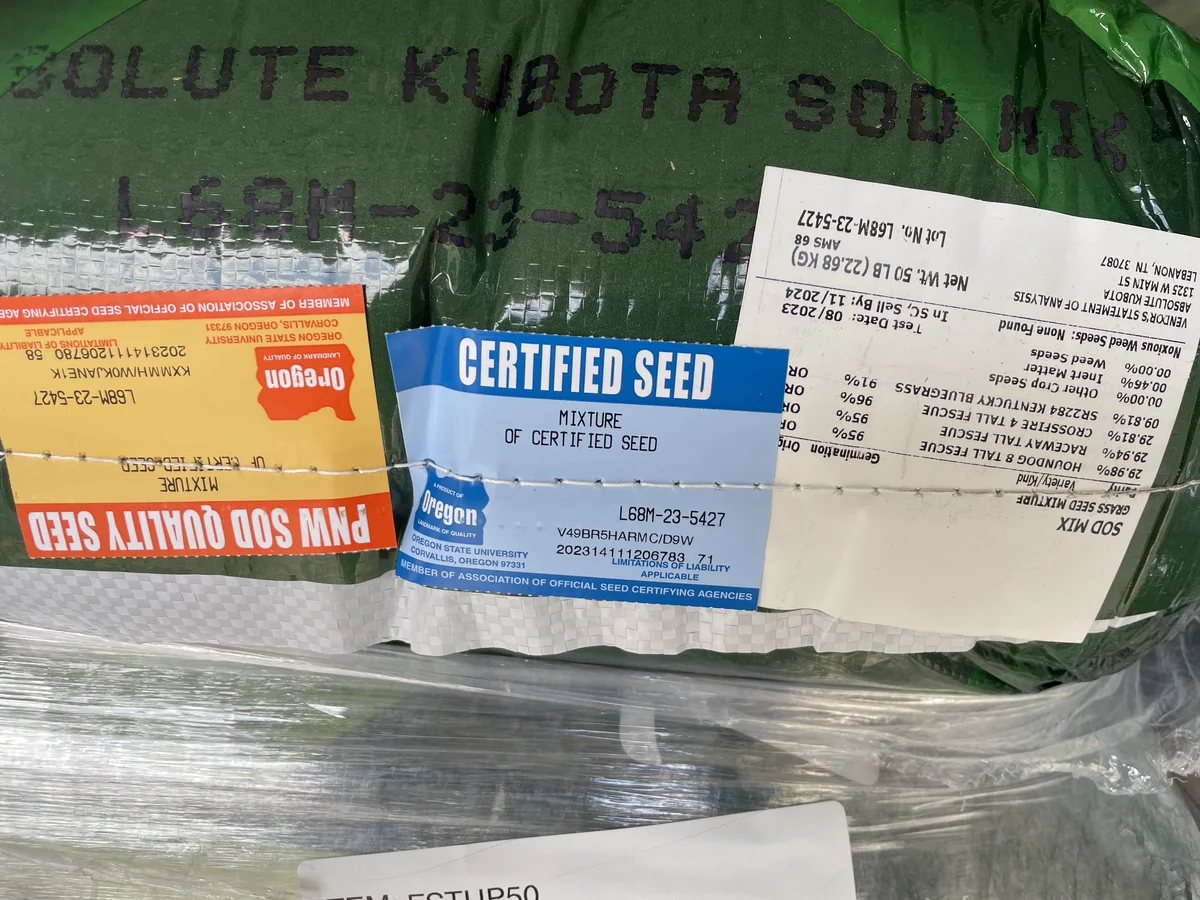
There are three certification levels and most homeowners have only ever seen the weakest one. The white tag on every bag is federal law: a statement of contents rather than a quality bar, and anyone can clear it. A blue tag means samples went to a land-grant university for spectral analysis and a grow-out to confirm the cultivar is what the label claims, against thresholds for noxious weed seed, other crop seed, and weed seed. Gold tag, Sod Quality Certified, is what I buy. The sample is roughly six times larger, noxious weed tolerance is zero, and there are field inspections through the growing year plus third-party inspection at harvest, at blending, and at final bagging. It is hard to source, which is why I contact 70 to 80 growers and licensed distributors every year to assemble the blend.

What is in the bag right now: turf-type tall fescues Traverse 2 SRP, 4th Millennium SRP, and Triad, with Barvette HGT Kentucky bluegrass as the 10 percent. All three fescues sit on UT Extension's list of statistically top-performing tall fescues for Tennessee (NTEP trials), and each was chosen for rhizomatous self-repair and brown patch resistance. Barvette HGT earns its own sentence: it establishes unusually fast for a Kentucky bluegrass, its rhizomes are what knit a small lot back together after a dog run or a mower rut, and it came out of Barenbrug's Healthy Grass Technology program, which stress tests specifically for the transition-zone persistence a Williamson County summer demands.

Set that against what came with the house. Contractor mix is cheap fescue cut with annual ryegrass, sold to look green at the final walkthrough, and cheap seed carries what cheap fields grow. Dallisgrass is the costly passenger. Oregon seed testing classifies it as other crop seed rather than a weed, so it rides in under a higher allowable threshold, and it is a summer perennial: seeded in fall, invisible until the following July, then three to five years of selective work to get rid of. Johnson grass, quackgrass, and Poa trivialis arrive by the same door.

04

Aeration is how the seed gets past your driveway edge

I have never seen a tree drop an acorn with a core aerator attached to it. Throw seed on the ground and roughly 90 percent of it finds somewhere to grow. I cannot run a business on 90 percent, though, and the missing 10 percent is never randomly scattered. On a Cool Springs lot it is the same ground every time: the strip along the driveway, the curb edge, the sidewalk margin where common Bermuda grass, Cynodon dactylon, has matted over the soil in the heat coming off pavement. Small lots have a high ratio of hardscape edge to turf, so that ground is a bigger share of your lawn than it would be on an acre.

On open turf, in my experience, aeration improves seed establishment a modest 10 to 15 percent over broadcasting alone. Through a Bermuda mat it runs closer to 75 to 90 percent, because the holes are the only route seed has to real soil. I run parallel passes and then a second set at 45 degrees rather than 90, which lays down a diamond and yields more holes per square foot, and seed drops through a metered seeder mounted on the aerator instead of a spinner that would fling a good share of it into your mulch beds and the neighbor's driveway.

On compaction you get the accurate version rather than the sales version. Core aeration does relieve compaction, and it is essentially the only method that does so without tearing the lawn out, but the relief is temporary because the holes close within weeks, and it takes real core density. K-State puts effective cultivation at 15 to 30 cores per square foot, and one commercial pass delivers about half of that, which I go through in one aeration pass does nothing for compaction. Genuine compaction is also rarer than the industry implies, because freeze-thaw cycles and root channels work against it all year. The yards that truly have it are the ones people keep re-compacting, and those are the ones I would book for a second visit in spring through the standalone core and liquid aeration service. In fall, aeration earns its price through what it does for the seed.

05

Liquid aeration, water, and the guarantee

If you do have irrigation, and many newer Cool Springs homes do, water daily through establishment. Results show in as little as seven to ten days on a lawn watered every day. Seed rates run six to seven pounds per thousand square feet on a typical lawn, down to three when I am only thickening a stand that is already decent. Most properties here take two to three hours start to finish. Everything I put down is guaranteed to germinate within 30 days, and if I miss an area or it does not come in, I re-aerate and reseed that area at no charge.

Term, Defined

Liquid aeration

Liquid aeration is included in this service and goes down with the cores. Be precise about what it does: it holds moisture in the top of the soil profile, right at seed depth, through the weeks when the seedling is still living on its own reserves. That buys germination speed, not germination rate. The same percentage of seed comes up either way, it simply comes up sooner. On a lawn with no irrigation that is the difference that matters most, and plenty of the older streets over here have no system at all.

Why Lawn Aeration & Seeding Matters in Cool Springs

Middle Tennessee sits in the transition zone where both cool-season and warm-season grasses struggle. Fescue is the best choice for the region, but it requires annual overseeding to maintain density because it does not spread laterally like bermuda or zoysia. The summer heat stress common in the I-65 corridor thins fescue lawns every year, making fall overseeding an essential annual maintenance practice.

What's Included in Our Lawn Aeration & Seeding for Cool Springs

  • Premium turf-type tall fescue seed blend
  • Professional-rate seed application with calibrated equipment
  • Seedbed preparation recommendations
  • Core aeration coordination (recommended)
  • Detailed post-seeding watering schedule
  • Germination monitoring and follow-up

Cool Springs Neighborhoods We Serve

We provide lawn aeration & seeding to all Cool Springs neighborhoods, including:

Free Lawn Aeration & Seeding Quote

Get a customized lawn aeration & seeding plan for your Cool Springs property.

Request a QuoteOr call (615) 490-4082

UT Certified Lawn Care Professional

Tennessee Turfgrass Association Member

Turfgrass Water Conservation Alliance Member

Nextdoor Neighborhood Favorite

BBB A+ Accredited

Lawn Aeration & Seeding in Cool Springs · FAQ

When should I seed my lawn in Cool Springs, TN?

Late August through mid September. UT Extension names that window in publications PB 1576 and W 160-F, and it matches what I see in the field. The mechanism is the seed pod: a fescue seedling lives on internal reserves for roughly four weeks, so it does not need pleasant weather to start, it needs pleasant weather once those reserves are spent. Seed the last week of August and that moment lands on prime fall conditions. Seed in October and the plant is still small when the first cold snap arrives.

Is aeration and seeding worth paying for on a small Cool Springs lot?

Usually more worth it than on a big one, for two reasons. Cost is figured per thousand square feet, so a small lot is a small invoice. And a small lot is almost all curb view, so a thin stand has nowhere to hide. Even three pounds per thousand on a decent lawn adds enough volume to sharpen mower stripes and edges from the street. Done once with modern certified cultivars, the seeding typically holds about three years, which makes the annual cost genuinely minor.

My builder seeded this yard a few years ago. Why does it look worse every summer?

Two separate problems arrived in the same bag. Contractor mix is old genetics, so the lawn was on an annual reseed clock the day you closed. It is also cheap seed, which means weed seed the grower could not control in the field came along with it. Dallisgrass is the one that hurts: a summer perennial that stays invisible through its first winter, then shows up the following July as coarse clumps that take me three to five years to remove selectively. One overseed with gold tag certified seed fixes the genetics. The contaminants take longer, but we stop adding new ones.

Bermuda grass keeps creeping in from the driveway and sidewalk. Will seeding stop it?

Seeding is half of it. Bermuda grass thrives on the heat radiating off hardscape and spreads from rhizome pieces rather than seed, so on a small lot with a lot of pavement edge it has a real beachhead. A dense fescue stand shades the soil and slows it considerably. Aeration matters most exactly here, because seed broadcast onto a Bermuda mat never touches soil, and cores punch through and give it a seedbed. Full suppression also runs through the treatment program, but thickening the stand is what everything else builds on.

Do you service Cool Springs, or do I book it as Franklin?

Same routes either way, and I quote by the property rather than the mailing label. Cool Springs is inside Franklin on paper, but the neighborhoods around the Galleria corridor, McKay’s Mill, Lockwood Glen, Falcon Creek, and Polk Place all sit inside my regular Williamson County coverage. The smaller lot sizes make the aeration and seeding visit efficient, which is part of why the price works out well here. Fall slots fill in booking order, so if you want the front of the late-August window, get on the list during summer.

What Cool Springs Customers Say

5.0·100+ verified reviews across Google, Yelp, Nextdoor & Facebook

S.B.

Spring Hill, TN

Google

AJ is wonderful. We are so happy that we chose him to do our yard. We now have carpet grass instead of weeds and dirt. After trying to create a carpet of grass for 14 years and failing, We hired AJ (Mr. Lawn). He tested… Read S.B.'s full review

View on Google

T.O.

Lewisburg, TN

Google

In just one year Mr Lawn has transformed my yard. I trust AJ with my yard. Here are before and after photos.

View on Google

B.M.

Spring Hill, TN

Google

Mr Lawn was hired to restore our lawn, killed by our previous service. He has been successful. His earth friendly quality products, personalized attention to the needs of our yard, knowledge (he will discuss the… Read B.M.'s full review

View on Google

K.D.

Franklin, TN

Google

A year ago our lawn was full of weeds and crabgrass. A.J. has done a wonderful job of restoring our lawn to a nice green beautiful lawn.

View on Google

D.J.

Franklin, TN

Google

As a former chemistry teacher and graduate of Clemson, I appreciate AJ's knowledge and information. I am able to give excellent aftercare by following his emailed instructions. Please sign up for one year and you will… Read D.J.'s full review

View on Google

T.S.

Spring Hill, TN

Google

AJ does a very good job of communicating with me. My lawn is full and green. I would recommend this gentleman to anyone looking to improve their yard.

View on Google

Real Lawn Aeration & Seeding Results in Cool Springs, TN

Actual photos from lawn aeration & seeding jobs in Cool Springs and surrounding Middle Tennessee areas.

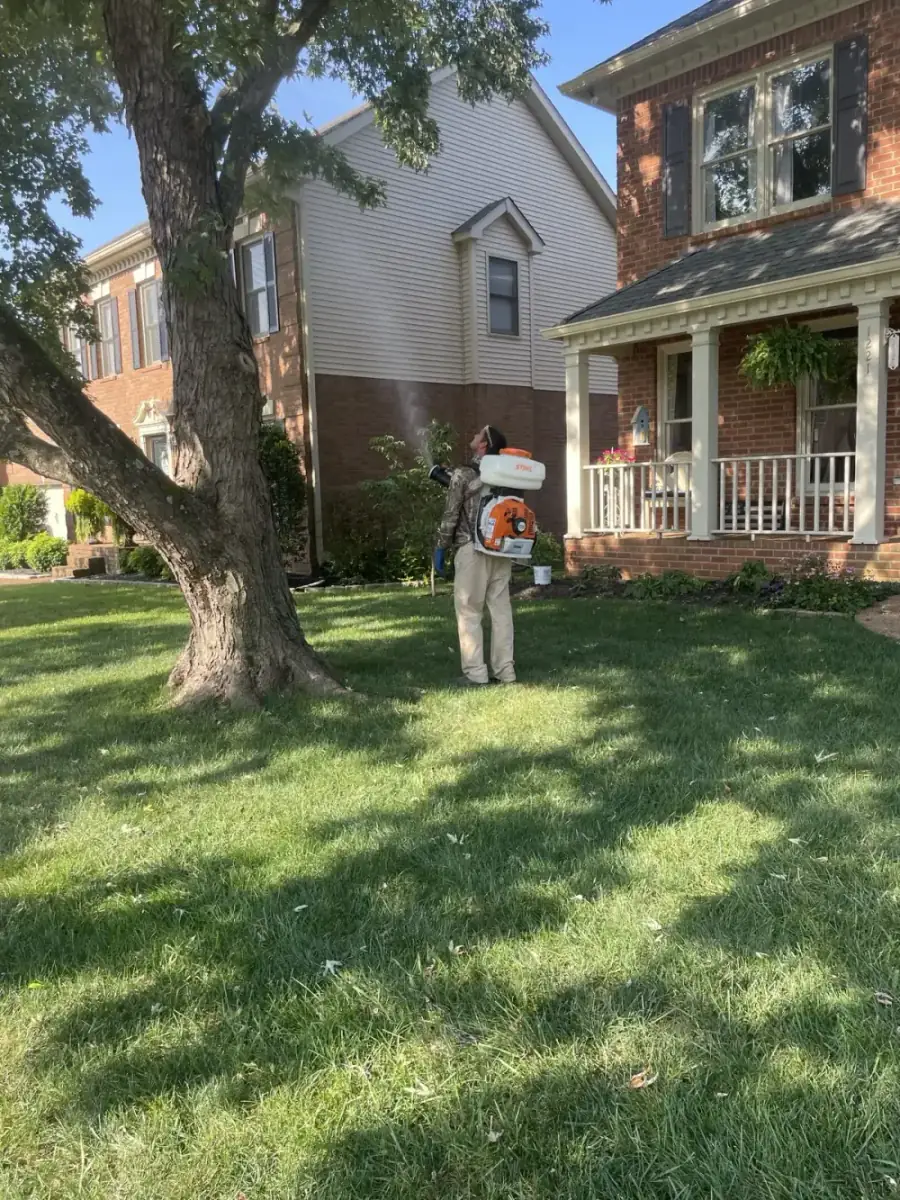
Bee-safe mosquito flea and tick yard treatment service in Middle Tennessee
Mosquito & Tick Treatment
Sod Quality Seed Blend 9010 Sod Mix Fescue to Kentucky Bluegrass, Mr. Lawn Care, Middle Tennessee lawn treatment
Sod Quality Seed Blend 9010 Sod Mix Fescue to Kentucky Bluegrass
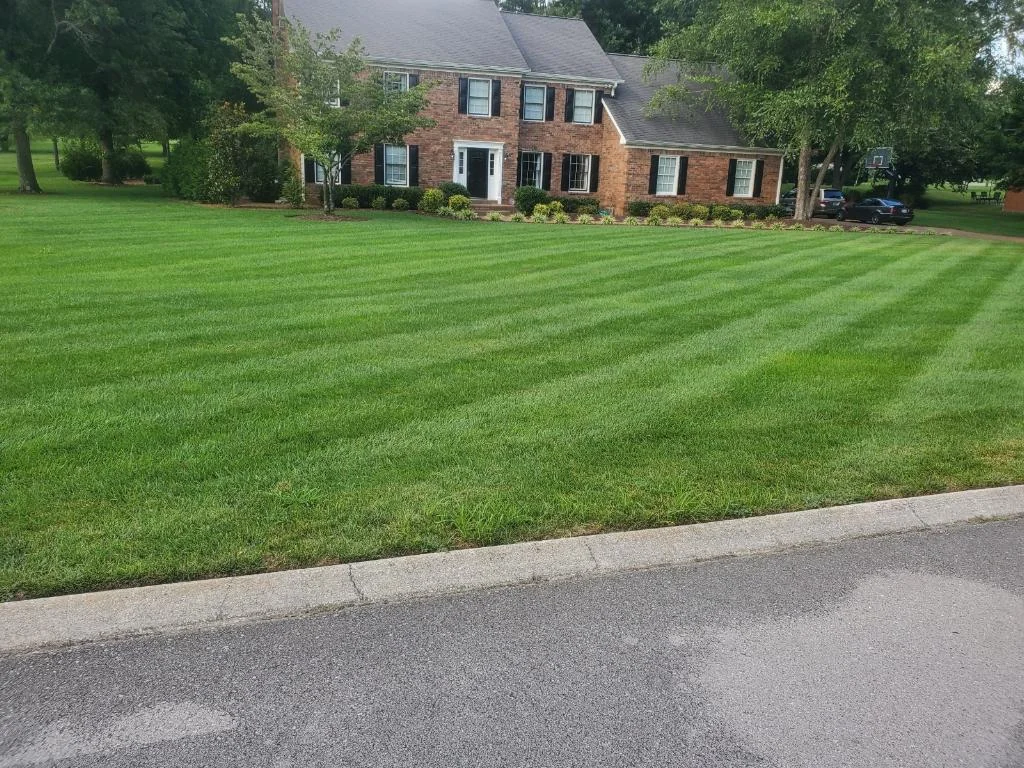
Beautiful Fescue Lawn This Stripes, Mr. Lawn Care, Middle Tennessee lawn treatment
Beautiful Fescue Lawn This Stripes
Mr. Lawn Care treated lawn vs untreated lawn comparison in Middle Tennessee
Lawn Care Comparison

Ready for Lawn Aeration & Seeding in Cool Springs?

Get a free quote for professional lawn aeration & seeding from our UT Certified team. We serve all of Cool Springs and surrounding Williamson County areas.