About Willow Oak
Willow Oak (Quercus phellos)
Full sun, moderately wet to medium moisture, grows in sandy loam, loam, clay loam, and clay; requires acidic pH (4.5-6.5), susceptible to iron chlorosis on neutral or alkaline soils.
40-75 feet tall by 30-50 feet wide; blooms in spring with slender male catkins as leaves emerge; acorns very small, 0.8-1.3 cm, nearly spherical with a thin shallow cup, requiring two growing seasons to mature. Growth rate medium to fast.
Germination Code C (cold stratification, 30-45 days); shallow fibrous root system makes transplanting easier than most red-group oaks.
Native region: West Tennessee lowlands and river bottoms; scattered in Middle Tennessee along stream terraces; uncommon but present in the Cumberland River drainage.
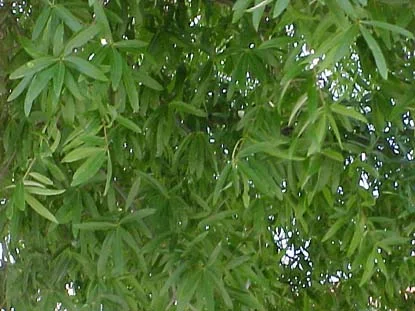
The willow-like leaves, linear, entire, without lobes or teeth, 51-127 mm long, make Quercus phellos instantly recognizable as an oak anomaly. Fine-textured foliage creates a light, airy canopy that casts dappled rather than dense shade. It is widely planted as a street tree across Tennessee cities because of its fibrous root system (which does not heave pavement as aggressively as taprooted oaks), tolerance of wet clay, and relatively fast growth. Iron chlorosis is a significant limitation on the alkaline limestone soils of inner Middle Tennessee: verify pH is below 6.5 before installation in the Columbia area. Acorn crop is very heavy despite the small nut size and is disproportionately important to wood ducks, mallards, and small mammals. UT Extension shade tree publications cover the oak disease and defoliator complex applicable to this species.
Quick Facts
- Common Name
- Willow Oak
- Scientific Name
- Quercus phellos
- Plant Type
- Tree
- Region
- Middle Tennessee