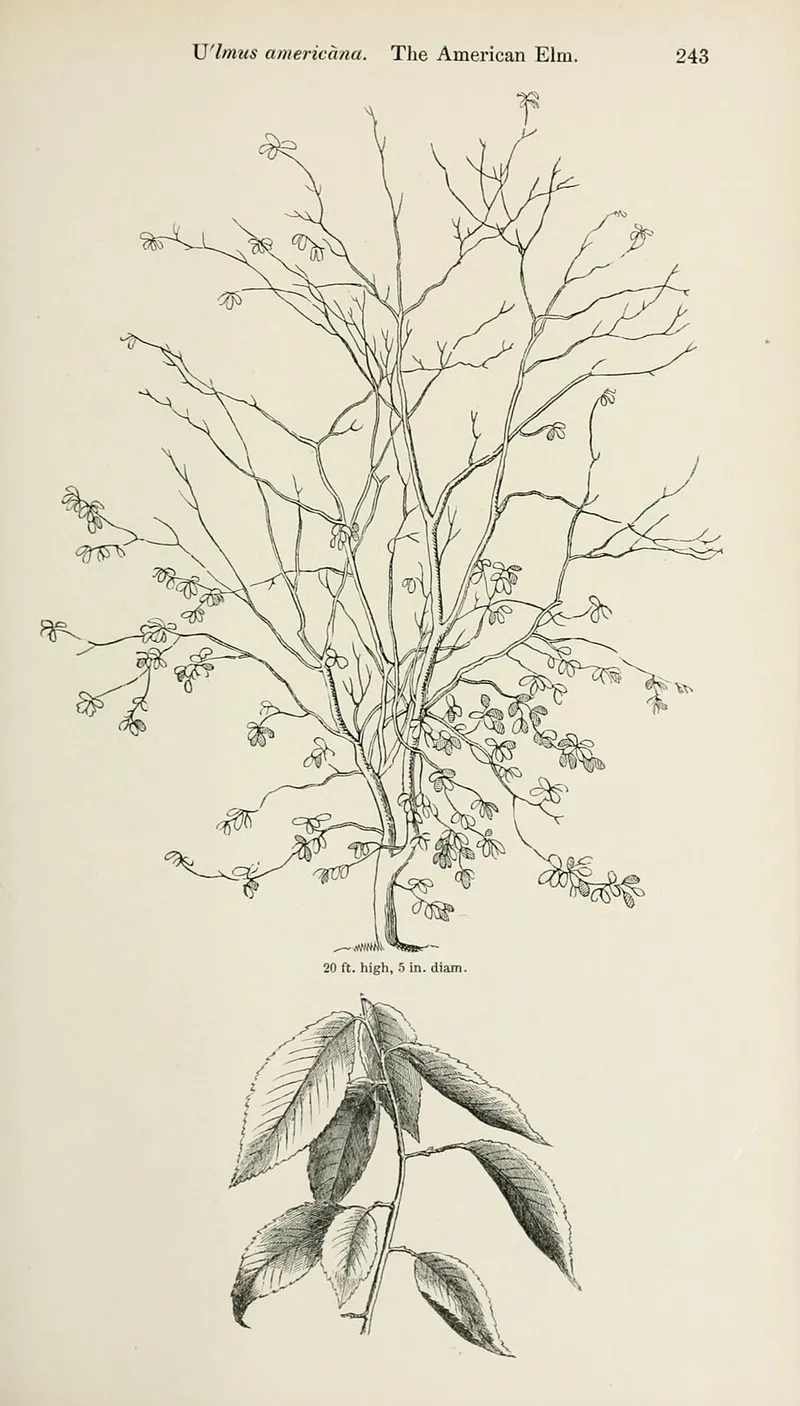
About American Elm
American Elm (Ulmus americana)
White Elm
Full to part sun, moderately moist to medium moisture, tolerates a wide range of soils including heavy clay and wet bottomlands, pH 5.5-8.0.
60-90 feet tall by 60-90 feet wide; inconspicuous red-tinged flowers in February-March before leaf-out; fruit is a small, flat, winged samara with a notched tip, ripening in spring. Growth rate fast.
Seed germination code A, seeds germinate immediately upon falling and require no cold stratification; must be sown fresh.
Native region: Statewide in Tennessee, most abundant in bottomlands, floodplains, and stream banks of Middle and West Tennessee.
Ulmus americana was the dominant street tree across American cities until Dutch Elm Disease (Ophiostoma ulmi / O. novo-ulmi), spread by the elm bark beetle (Scolytus spp.), eliminated most mature specimens from the 1960s onward. Disease-tolerant cultivars ('Valley Forge', 'Princeton') offer the classic vase form with substantially improved resistance and are recommended for new plantings in Middle Tennessee. Elm yellows (phytoplasma) is a second lethal disease present in the region. Surviving native elms along Tennessee creek corridors provide important mast and cavity habitat. When planting, choose resistant cultivars and maintain soil health with mulch to reduce stress-related susceptibility.
Quick Facts
- Common Name
- American Elm
- Scientific Name
- Ulmus americana
- Plant Type
- Tree
- Region
- Middle Tennessee