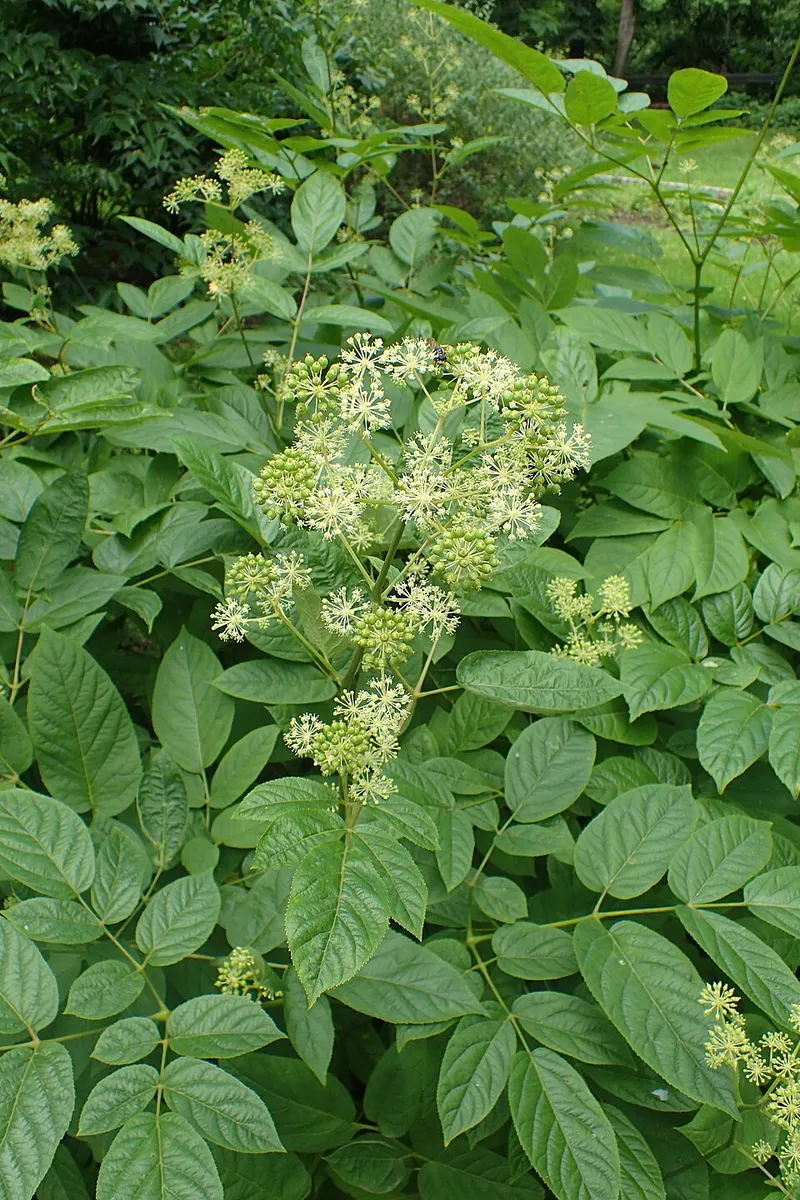
About Japanese Spikenard
Japanese Spikenard (Aralia cordata)
Udo, Mountain Asparagus
Part shade to full shade, moderately moist to moist, rich humusy soil; pH 5.5-6.5; tolerates clay with organic amendment; requires consistent moisture through summer.
90-120 cm tall in leaf, dying back fully to ground each winter; blooms July-August with white compound umbels on arching stems; spreads slowly by rhizomes to form clumps.
Division of the thick rhizome in early spring before emergence is the standard propagation method.
Native region: Not native to Tennessee; ornamental introduction from Japan and China.
Despite its height, Aralia cordata functions as a groundcover in the sense of filling large shaded areas under mature canopy where smaller groundcovers fail, the bold, tropical-looking compound leaves suppress competing vegetation effectively. The cultivar 'Sun King' with chartreuse-gold foliage is particularly useful for brightening dark corners in Middle Tennessee shade gardens. Crowns emerge late in spring, well into May, so mark planting locations to avoid accidental damage. Young shoots were historically harvested and eaten in East Asia; the large leaves and arching flower panicles attract pollinators. No significant pest issues in Tennessee; slugs can damage new growth in wet springs.
Quick Facts
- Common Name
- Japanese Spikenard
- Scientific Name
- Aralia cordata
- Plant Type
- Groundcover
- Region
- Middle Tennessee