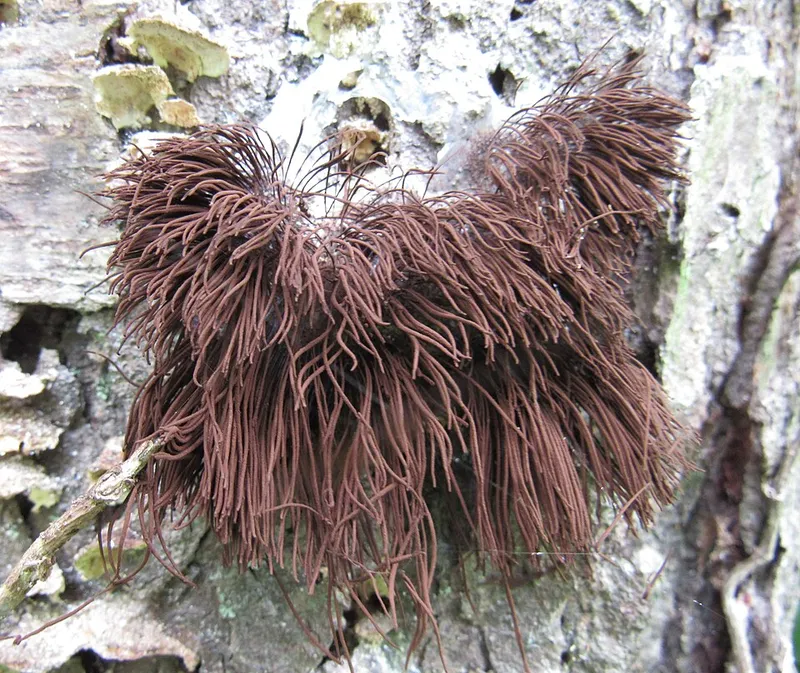
About slime mold
Slime mold isn’t a turf disease in the traditional sense, and it’s certainly not something that’s going to kill your lawn. In Middle Tennessee, we deal with several species, but Physarum polycephalum is one of the most common. It’s actually a primitive organism called a Myxomycete, part of the Protist kingdom, that behaves more like a giant, single-celled amoeba than a fungus. It doesn’t feed on your grass blades or roots. Instead, it lives in the thatch layer feeding on bacteria and decaying organic matter. When the weather gets right, it simply uses your fescue blades as a structural ladder to climb up and release its spores into the air. It’s essentially a house guest that’s just using your lawn as a staging ground.
Identifying slime mold in the field is usually pretty easy because it looks like a science experiment gone wrong. You’ll walk out into your yard in Columbia or Spring Hill after a series of heavy summer thunderstorms and see what looks like someone dumped a bucket of ash or purple soot on the grass. It typically starts as a slimy, colorful mass, often white, gray, or even a translucent purple, and then hardens into a crusty, powdery blob. These patches are usually the size of a dinner plate. If you hit it with a lawnmower or step on it, a dark cloud of spores will puff up. It’s especially noticeable on broad-leafed fescue cultivars like '4th Millennium' or 'Crossfire 4' because the wider blades give the organism more surface area to colonize.
In our Middle Tennessee transition zone, slime mold is a direct result of our subtropical humidity. From June through August, when we get those 90-degree days followed by 75-degree nights and the dew keeps the plants wet for 12 hours or more, you’re going to see it. While it doesn't infect the plant tissue, it can be a minor issue if the coverage is thick enough to block sunlight. If the slime sits on the leaf for a week, it prevents photosynthesis, and you might see some temporary yellowing or chlorosis once it’s gone. In places like Franklin and Brentwood where homeowners are meticulous about their curb appeal, this "disease" often causes unnecessary panic.
My approach to treatment is simple: save your money. I’ve seen plenty of guys try to treat this with standard fungicides like propiconazole, but that’s a complete waste of time and chemistry because slime mold isn't a true fungus. If the look of it bothers you, the best "treatment" is a garden hose. A high-pressure stream of water will wash the mass off the blades and break it up, which stops the growth. Mowing over it does the same thing. If you absolutely feel like you have to spray something, UT Extension mentions mancozeb as an option, but for a residential lawn in Tennessee, that is total overkill. Just wait for the sun to come out and the humidity to drop; the problem will solve itself as soon as things dry out.
Quick Facts
- Common Name
- slime mold
- Scientific Name
- Physarum polycephalum
- Type
- Lawn & Landscape Disease
- Region
- Middle Tennessee