About Herbicide Damage
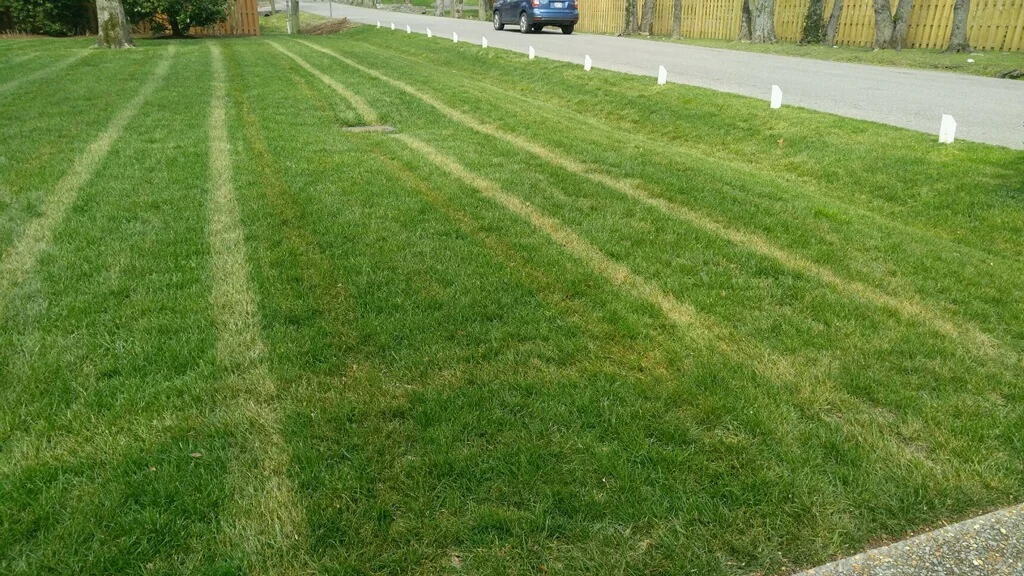
These aren't photos of my work, these are lawns that customers brought me after something went wrong. A company sprayed at the wrong rate, or in the wrong temperature window, or with a machine that wasn't calibrated, and the homeowner is the one paying for it. I'm showing these because if your lawn looks like any of the photos on this page, it's not a mystery disease, someone put the wrong chemistry on the grass, and you can see the evidence.
The two photos showing tire-track patterns are the giveaway. When a fertilizer or herbicide cakes up on the tires of an applicator and then drops off in concentrated amounts as the tires rotate, you get sharp stripes of dead grass exactly as wide as the tire. That's over-application, not disease. A properly calibrated Stinger Gateway applicator, which is what I run, cleans itself as it moves and applies at the labeled rate. Cheap push spreaders and broken ride-on units with clogged hoppers don't do that. They dump.
The other common cause I see is homeowners who unknowingly exceed the annual 2,4-D limit. Practically every combo herbicide at a big-box store contains 2,4-D. The label allows two blanket applications per year, at least thirty days apart. Homeowners apply a weed-and-feed in spring, then spot-spray with a liquid product in summer that also contains 2,4-D, and they've already doubled their legal annual count without knowing it. The lawn goes yellow, the grass thins out, and they wonder what happened.
Temperature is the other big one. Ester-based herbicides are more effective on tough weeds like Virginia buttonweed and wild violet than amine-based formulations, but esters are volatile. Above roughly 80 degrees, the chemistry becomes unstable enough to damage fescue even when the active ingredient is supposed to be selective for broadleaves. That's why the most effective products for summer weeds cannot be used in the summer. You have to hit those weeds in spring or fall. If somebody sprayed your lawn in July for nutsedge and it yellowed the fescue around it, that was ester volatility, not the nutsedge fighting back.
There's also a safety issue homeowners rarely hear about: morning dew re-suspends 2,4-D on grass blades, which means it becomes dislodgeable again. Morning samples show five to ten times more dislodgeable residue than afternoon samples, and it persists for at least six days after application. It comes off on shoes, bare feet, pet paws, and children walking to the school bus. That's one of the reasons I care about calibration and labeled rates, not just to avoid burning the grass, but to avoid leaving residue that shouldn't be there.
If you're seeing damage like this, the fix is usually to stop treating, water thoroughly to dilute what's on the surface, and wait. Fescue that's only top-killed can recover in three to six weeks with proper fertilization. Fescue that was hit hard enough to kill the crown needs to be overseeded in fall. I do free evaluations for customers who were burned by another company, bring me a photo, I'll tell you what I think happened and whether it can recover.
Quick Facts
- Common Name
- Herbicide Damage
- Scientific Name
- N/A
- Type
- Abiotic Disorder (Non-Living Cause)
- Region
- Middle Tennessee