About Fertilizer Burn & Striping
Actual fertilizer burn, where grass dies from over-application, is surprisingly uncommon. The most common cause is a homeowner hitting a bump on their push spreader, causing fertilizer to slosh out of the hopper in a concentrated pile on one spot. That spot burns, and you get a brown circle with a green ring that looks identical to dog urine damage.
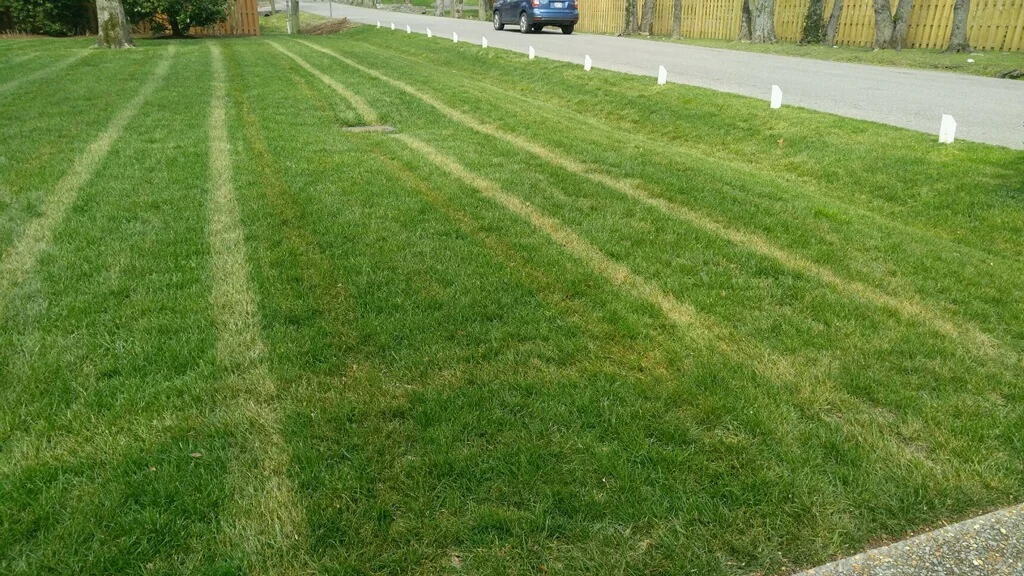
What homeowners actually see far more often is fertilizer striping: alternating bands of dark green and light green grass across the lawn. This is caused by uncalibrated spreader application, walking too slow (over-applying in that pass), walking too fast (under-applying), making passes too narrow (overlap zones get double the rate), or making passes too wide (gaps between passes get zero product).
Scotts brand broadcast spreaders have a specific design flaw worth knowing about. The wheels are hollow, and fertilizer gets trapped inside the wheel cavity. As the wheel rotates, it drops the trapped fertilizer in a thin, perfectly straight line directly under the wheel path. The result is distinctive thin dark-green stripes that follow the exact wheel tracks. If you see perfectly straight, thin green lines on a lawn, check whether the homeowner uses a Scotts spreader.
The fix for fertilizer striping is straightforward: apply fertilizer at a lower rate at a perpendicular angle (ninety degrees) to the original striped passes. The perpendicular application evens out the distribution across the under- and over-applied zones. Alternatively, if you are confident in your technique, you can apply a reduced rate directly into the under-fertilized light-green strips only. Either approach blends out the striping within one to two mowing cycles.
Quick Facts
- Common Name
- Fertilizer Burn & Striping
- Scientific Name
- N/A
- Type
- Abiotic Disorder (Non-Living Cause)
- Region
- Middle Tennessee